About Leopardus wiedii (Schinz, 1821)
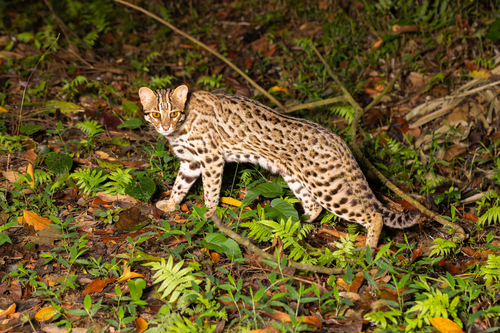
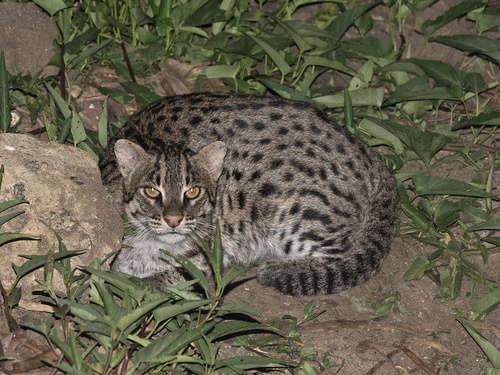
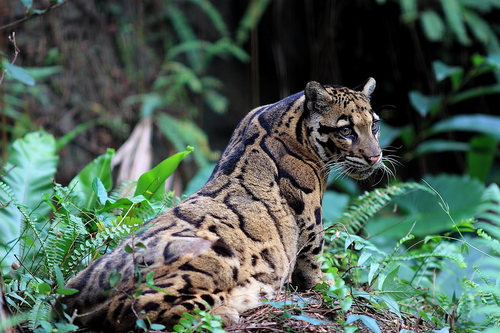
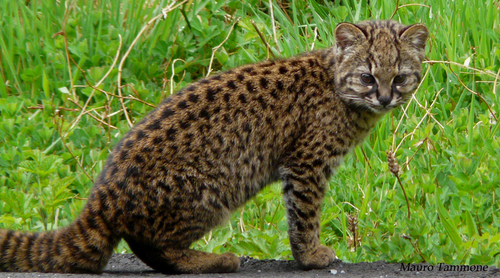
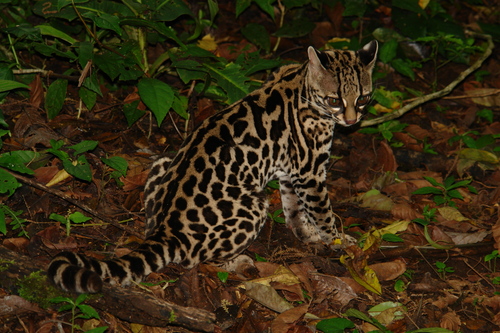
Characteristics: The margay (Leopardus wiedii) is very similar in appearance to the larger ocelot (Leopardus pardalis), though it has a slightly shorter head, larger eyes, and longer tail and legs. It weighs 2.6 to 4 kg (5.7 to 8.8 lb), has a body length of 48 to 79 cm (19 to 31 in), and a tail length of 33 to 51 cm (13 to 20 in). Unlike most other cats, female margays only have two teats. Its fur is brown, marked with numerous rows of dark brown or black rosettes and longitudinal streaks. Its undersides are paler, ranging from buff to white, the tail has numerous dark bands and a black tip, and the backs of its ears are black with circular white markings at the center.
Distribution and habitat: The margay ranges from tropical lowlands in Mexico, through Central America, to Brazil and Paraguay. In Mexico, it has been recorded in 24 of 32 states, extending north along coastal lowlands and the Sierra Madres as far north as Coahuila, Nuevo Leon, and Tamaulipas on the eastern U.S. border, and southern Sonora in the west. The southern edge of its range reaches Uruguay and northern Argentina. It lives almost exclusively in dense forests, including tropical evergreen forest, tropical dry forest, and high cloud forest. It has occasionally been observed in coffee and cocoa plantations. The only record of a margay in the United States was collected before 1852 near Eagle Pass, Maverick County, Texas, and it is currently considered locally extinct in Texas. The IUCN Red List considers the margay’s presence in the United States "uncertain".
Behavior and ecology: The margay is a skillful climber, and is sometimes colloquially called the tree ocelot because of this ability. It spends most of its time in trees, leaping after and chasing birds and monkeys through treetops. It can rotate its ankles up to 180 degrees, allowing it to grasp branches equally well with its front and hind paws, and can jump up to 3.7 m (12 ft) horizontally. It also uses its long tail to maintain balance while climbing. These morphological adaptations show the margay is well equipped to thrive in forest ecosystems like rainforests, where vegetation provides protection from threats. Behavioral studies have found that margay population density is higher in environments with a large number of trees and minimal human disturbance. Margays are usually solitary, and occupy home ranges of 11–16 km² (4.2–6.2 sq mi). They use scent marking to indicate territory, including urine spraying and leaving scratch marks on the ground or branches. All of their vocalizations appear to be short range, and they do not call over long distances. One hunting observation recorded a margay mimicking the vocalization of an infant pied tamarin (Saguinus bicolor); this is the first recorded case of this type of mimicry used by a Neotropical predator.
Reproduction and lifecycle: Female margays experience estrus for four to ten days over a 32 to 36 day cycle, during which they attract males with a long, moaning call. Males respond by yelping, trilling, and rapidly shaking their heads from side to side – a behavior not documented in any other cat species. Copulation lasts up to sixty seconds, similar to that of domestic cats, occurs primarily in trees, and happens multiple times while the female is in heat. Unlike other felids, margays are not induced ovulators. Gestation lasts around 80 days, and usually produces a single kitten (two is very rare), most often between March and June. Newborn kittens weigh 85 to 170 g (3.0 to 6.0 oz). This birth weight is relatively large for a small cat, and is likely related to the long gestation period. Kittens open their eyes at around two weeks old, and begin eating solid food at seven to eight weeks. Margays reach sexual maturity at 12 to 18 months of age, and have been reported to live more than 20 years in captivity.