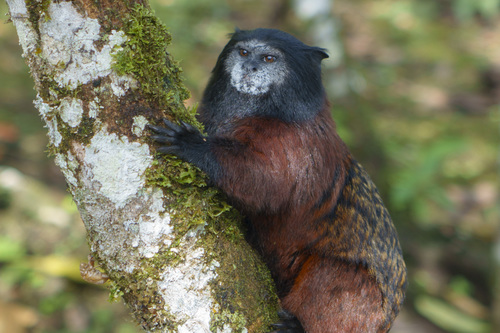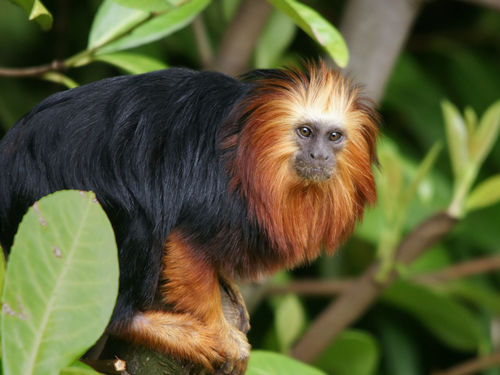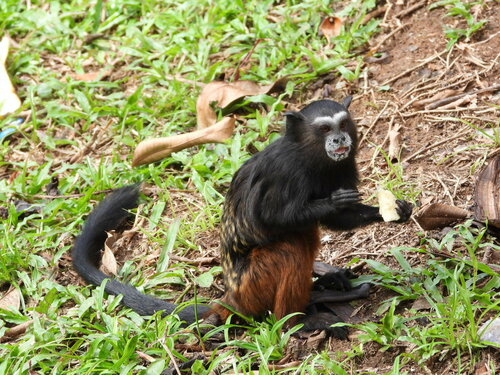
About Leontocebus weddelli (Deville, 1849)
Scientific Classification
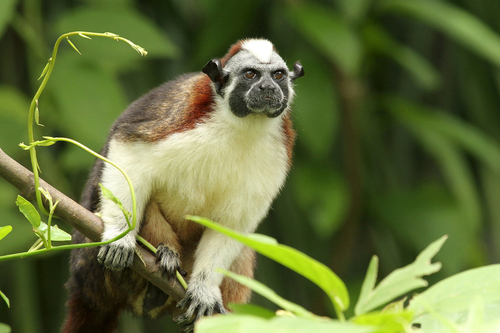
Weddell's saddle-back tamarin, scientifically named Leontocebus weddelli, is a species of saddle-back tamarin, a small South American monkey. It was formerly classified as a subspecies of the brown-mantled tamarin, Leontocebus fuscicollis.
Distribution
This species is found in Brazil, Bolivia, and Peru, and its type locality is located in Bolivia.
Subspecies
It has three recognized subspecies: Leontocebus weddelli weddelli, Crandall's saddle-back tamarin (Leontocebus weddelli crandalli), and the white-mantled tamarin, also called the white saddle-back tamarin (Leontocebus weddelli melanoleucus).
Head and Body Length
Males have an average head and body length of around 190.0 millimetres (7.48 in), while females have an average head and body length of approximately 196.6 millimetres (7.74 in).
Tail Length
The tail of Weddell's saddle-back tamarin ranges from 250 millimetres (9.8 in) to 300 millimetres (12 in) in length.
Weight
On average, males weigh about 359 grams (12.7 oz) and females weigh about 357 grams (12.6 oz).
Diet
The diet of Weddell's saddle-back tamarin includes fruits, gums, nectar, insects, and other small animals.
Social Group Structure
This species lives in a variety of social group structures: groups with a single adult male and single adult female, multi-male multi-female groups, single-male multi-female groups, and single-female multi-male groups.
Female Natal Dispersal
Female Weddell's saddle-back tamarins sometimes stay in their natal group.
Interspecies Associations
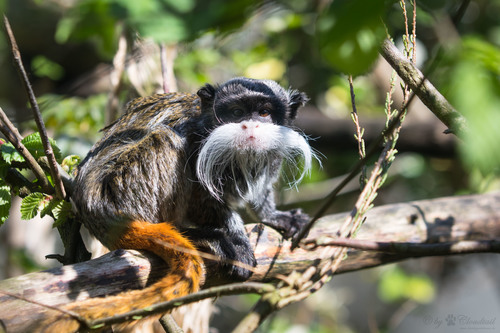
The species associates with emperor tamarins, red-bellied tamarins, and Goeldi's marmosets.
Conservation Status
The International Union for Conservation of Nature (IUCN) assesses Weddell's saddle-back tamarin as a species of least concern for conservation status.