About Chroicocephalus bulleri (F.W.Hutton, 1871)
Adult Size Measurements
A healthy adult black-billed gull (Chroicocephalus bulleri) is typically 35–38 cm long, with a wingspan of 81–96 cm, and a weight of around 230g.
Plumage Coloration
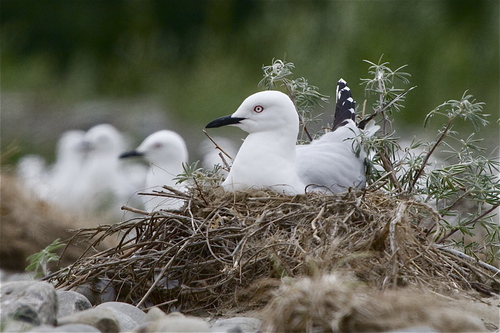
The head, body, and parts of the wings are white, with silvery grey on the saddle and wings, and black edging along the wing margins.
Seasonal Color Change
This species undergoes seasonal color change. The orbital ring is black from February to June, and becomes orange-red, red, or dark red for the remainder of the year. The legs also change color, shifting from black to dark red and even bright red as the breeding season progresses; this change is "possibly stimulated by presence of begging chicks and juveniles."
Sexual Dimorphism Status
Observations indicate that the black-billed gull is sexually dimorphic, but there is no published data to confirm this claim.
Geographical Variation Status
There is also a lack of published data regarding geographical variation across the species' range.
Distinction from Red-billed Gull
The black-billed gull is easily confused with the red-billed gull, but can be distinguished by its black bill. It is also described as having a "more delicate appearance", a "more buoyant and graceful" flight, and being "generally less noisy" than the red-billed gull, despite having a similar call.
Hybrid Characteristics
F1 and F2 hybrids between the black-billed gull and red-billed gull have been observed, and both types of hybrid have dark red bills.
Endemic Range
The black-billed gull is endemic to New Zealand.
Population Concentration
An estimated up to 78% of the total population lives in the Southland region, at the southern end of the South Island.
Breeding Season Habitat
During the breeding season, the gull is found on major rivers (especially braided rivers), lakes, and farmland.
Non-breeding Season Habitat
Outside of the breeding season, it generally prefers estuaries and coastal areas, though some individuals remain at breeding sites year-round.
Human-associated Habitat
This gull is also attracted to urban areas, and "anywhere refuse of scraps available", such as rubbish dumps and freezing works. In 2019, a colony of around 300 black-billed gulls established itself in Christchurch Central City.
Altitudinal and Outlying Range
The species has occasionally been sighted on Stewart Island and The Snares, as well as at altitudes of up to 1700 meters above sea level on the New Zealand mainland.
North Island Colonization
Multiple colonies are also now found on the North Island; it was formerly only a visitor to the North Island, with the first recorded breeding taking place at Lake Rotorua in 1932.
Inter-island Movement
Some South Island black-billed gulls cross the Cook Strait after the breeding season to winter in the North Island.