About Chlidonias leucopterus (Temminck, 1815)
Taxonomy
This species has the scientific name Chlidonias leucopterus (Temminck, 1815).
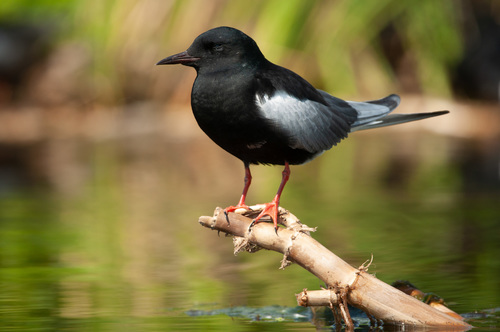
Summer Adult Bill & Legs
Description: Summer adult birds have short red legs and a short, small, stubby black bill. Measuring 22–25 mm from the base feathers, the bill is decidedly shorter than the head.
Plumage & Tail Features
They have a black neck, belly, and very dark grey back, often with a pale grey back tone. They also have a white rump and a light grey, almost white tail; juvenile birds of this species often have a distinctly square-looking tail.
Facial & Wing Markings
The face carries a yellowish tinge. As the species name suggests, the wings are mainly white. The inner wing is greyish, with coverts tipped brown.
Non-Breeding Body Plumage
In non-breeding plumage, most of the black plumage is replaced by white or pale grey, though a few blackish feathers may remain mixed in with white underparts. A considerable amount of black is visible on the underwing-coverts.
Non-Breeding Head Features
The head is black, with a white forehead. The crown is blackish-brown, flecked with white, and the hindcrown is blackish with a noticeable amount of white flecking; these white markings are very distinct on winter adults.
Eye Patch & Collar
There is a dark triangular patch located forward of the eye. The collar is fairly broad and white.
Juvenile & Moulting Rump
In juveniles and moulting adults, the rump is pale gray, turning grey in both life phases later in the year. The distinct clear white collar and rump separate the mantle into a dark brown 'saddle'.
Mantle Feather Tips
The mantle feathers have narrow paler brown tips, a trait shared by the tertials and scapulars.
Breeding Habitat
Distribution and habitat: Their breeding habitat is freshwater marshes spanning from southeast Europe to Central Asia and the Russian Far East. They usually nest either on floating marsh vegetation or on the ground very close to water.
Nesting & Egg Laying
They lay 2–4 eggs in a nest constructed from small reed stems and other vegetation.
Winter Range
In winter, they migrate to Africa, southern Asia and Australia.
Vagrant Records
It is a scarce vagrant in North America, found mainly on the Atlantic coast, though there are a few records from the Pacific coast and inland in the Great Lakes area. The species has also been recorded as a vagrant in South America, with confirmed records in Argentina, Brazil, Uruguay, and Colombia.