About Lampranthus glaucus (L.) N.E.Br.
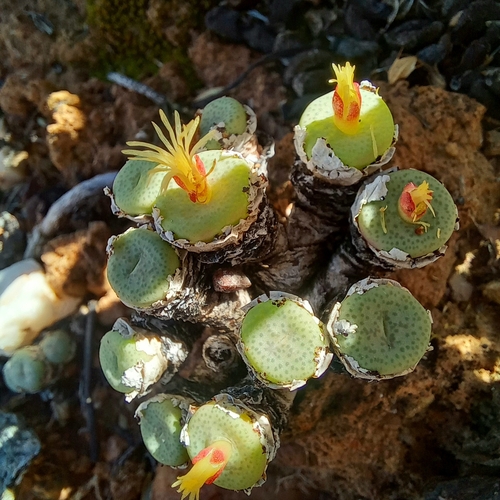
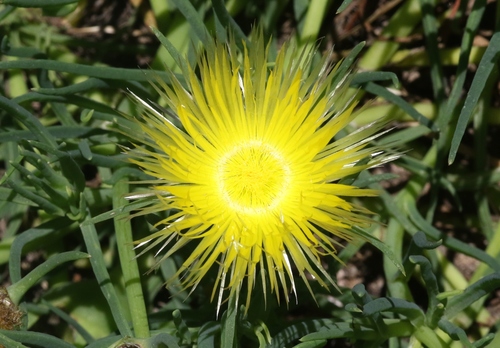
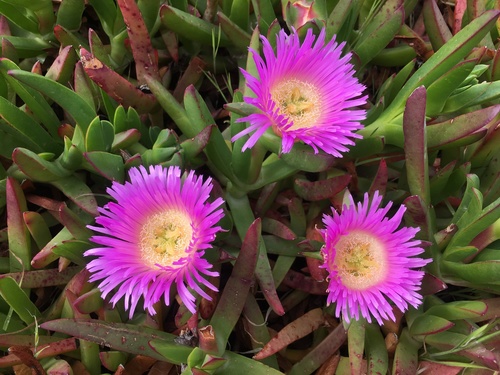
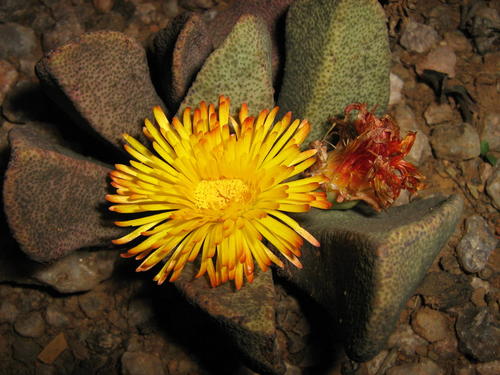
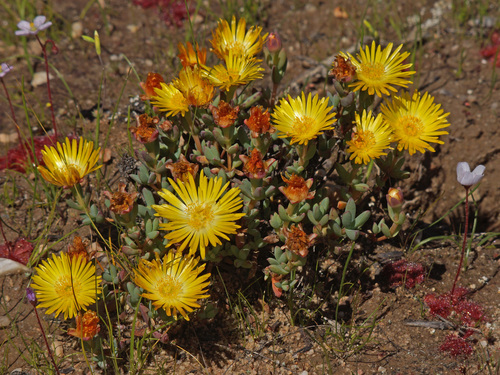
Lampranthus glaucus is a plant species in the genus Lampranthus that is native to South Africa and naturalized in gardens worldwide. It typically grows as a compact, rounded shrub reaching 0.1 to 0.3 metres (0.3 to 1.0 ft) in height. The species has succulent leaves and produces large numbers of orange to yellow flowers between August and October. Its flowers open fully in direct sun, which has earned them the common name of noon flowers. It grows well in well-drained sandy soils, and grows poorly in clay soils. L. glaucus is classified as an invasive introduced species in Western Australia and New Zealand. This species was first formally described by botanist Carl Linnaeus in 1753 in his publication Species Plantarum, under the name Mesembryanthemum glaucum. It was later reclassified into the genus Lampranthus as Lampranthus glaucus by Nicholas Edward Brown in 1930, published in the journal Gardeners' Chronicle. Several other taxonomic synonyms exist for this species, including Lampranthus glaucoides, Lampranthus aurantiacus, Mesembryanthemum aurantium and Mesembryanthemum aurantiacum.