About Carpobrotus chilensis (Molina) N.E.Br.
Stem Morphology
Carpobrotus chilensis (Molina) N.E.Br. produces prostrate stems over 2 metres (6+1⁄2 feet) long, which root at their nodes and can form a dense ground carpet.
Leaf Morphology
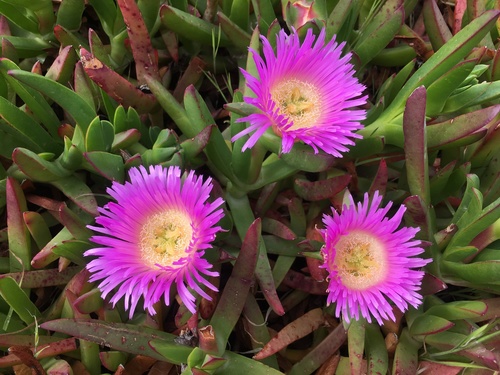
It has fleshy, pointed leaves 4–7.5 centimetres (1+1⁄2–3 inches) long that are triangular in cross-section.
Related Species
It is closely related to, and often confused with, Carpobrotus edulis, commonly called ice plant. C. edulis grows alongside C. chilensis, is larger overall, and sometimes hybridizes with this species.
Flower Comparison
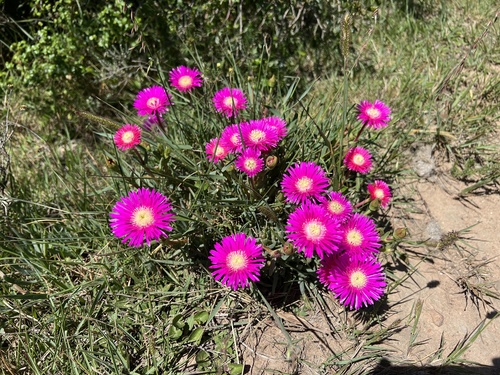
C. edulis has larger flowers, 6.4 to 15.2 cm (2.5 to 6 in) in diameter, that are yellow or light pink, while C. chilensis flowers are smaller, 3.8 to 6.4 cm (1.5 to 2.5 in) in diameter, and deep magenta.
Flower and Fruit Phenology
The flowers of C. chilensis open in the morning and close at night, and the plant can bloom and fruit year-round. Its fruit contains 8–10 chambers.
Propagation Method
This plant propagates easily from cuttings; cuttings can be planted directly into garden soil and will root without needing rooting hormone or mist.
Native Range
This species is most commonly found in warm temperate and subtropical regions, and it is probably native to southern Africa.
Introduced Distribution
It has become well established as an introduced invasive species in many other areas, most notably along the coastline of western North America where it is now very common. It is also naturalized in Argentina, Chile, Peru, Ecuador, Australia, Spain, Greece, Southern England and New Zealand.
Habitat Preferences
It grows in sunny locations, typically found on coastal dunes and bluffs, at the margins of estuaries, and along roadsides.
Elevation Range
Along the southern Pacific Coast of North America, it occurs at elevations from sea level up to 100 m (330 ft).
Environmental Tolerances
C. chilensis grows well in poor sandy soil, is hardy, and can tolerate human disturbance, which is frequent on heavily used beaches where it grows.
Ecological Impact
This tolerance gives it an advantage over many native plant species, making it a threat to native coastal ecosystems where it has invaded.
Edibility Notes
C. chilensis has a pleasant flavour, but eating large amounts, especially the fruit, can have a laxative effect. The plant, its leaves especially, can be eaten raw or cooked, dried for later use, or made into pickles and chutney.
Fruit Preparation
The fruit only contains a very small amount of flesh, and it must be fully ripe otherwise it is very sour.
Leaf Culinary Uses
Its leaves can be added to salads, and can also be used as a substitute for pickled cucumber.
Leaf Juice Properties
Leaf juice from C. chilensis is acerbic and mildly antiseptic.
Internal Medicinal Uses
When mixed with water, it is used to treat diarrhoea, dysentery and stomach cramps, and can be gargled to relieve laryngitis, sore throat and mouth infections. Chewing the tip of a leaf and swallowing the juice may also relieve a sore throat.
External Medicinal Uses
Applied externally, leaf juice acts as a calming treatment for burns, bruises, scrapes, cuts, grazes, sunburn, ringworm, eczema, dermatitis, herpes, nappy rash, cold sores, cracked lips, chafing, skin conditions and allergies, and also treats insect stings.