About Anthracothorax mango (Linnaeus, 1758)
Taxonomy and Basic Measurements
Jamaican mango, scientifically named Anthracothorax mango (Linnaeus, 1758), measures 11 to 12 cm (4.3 to 4.7 in) in length and weighs 8.5 to 9.1 g (0.30 to 0.32 oz). It differs from all other species in its genus by being dark overall rather than mostly bright green.
Adult Male Plumage (Upperparts)
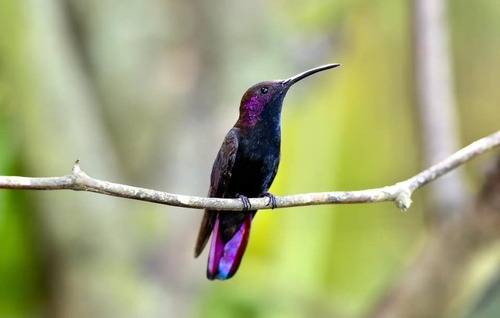
The adult male has a dull green crown, metallic magenta sides of the head and neck, and a dull greenish bronze back. Its central tail feathers are dusky bronze to dull black, and the rest of the tail feathers are metallic violet with a thin dark blue band.
Adult Male Plumage (Underparts)
The adult male's underparts are velvety black.
Adult Female Plumage
The adult female is similar to the male, but has faded velvety green flanks and white tips on the outer tail feathers.
Immature Male Plumage
The immature male has a deep blue throat that becomes the solid black of the adult throat after its second year.
Distribution
The Jamaican mango is found throughout the eponymous island of Jamaica, with its densest population along the northern coast.
Habitat
It inhabits a wide variety of open and semi-open landscapes, including forest edges, gardens, plantations, and arid areas, and it shuns mangrove areas.
Elevation Range
In terms of elevation, it mostly occurs between sea level and 800 m (2,600 ft); it is regular but rare at elevations as high as 1,500 m (4,900 ft).