About Lactoria cornuta (Linnaeus, 1758)
Sexual Dimorphism and Coloration
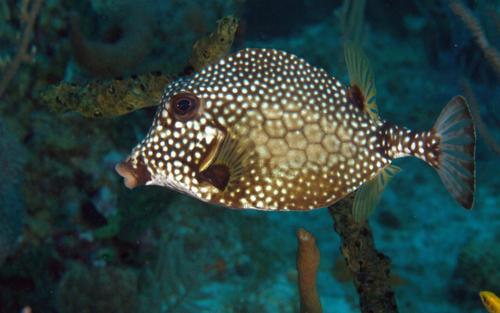
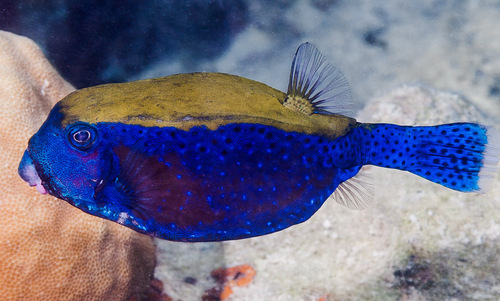
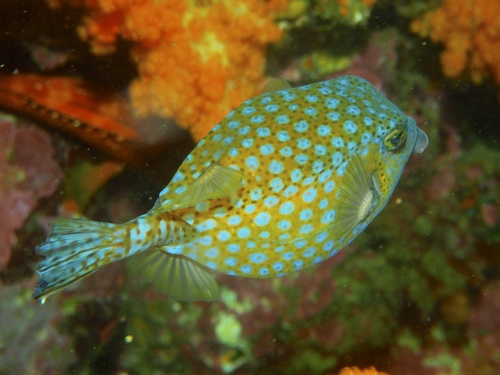
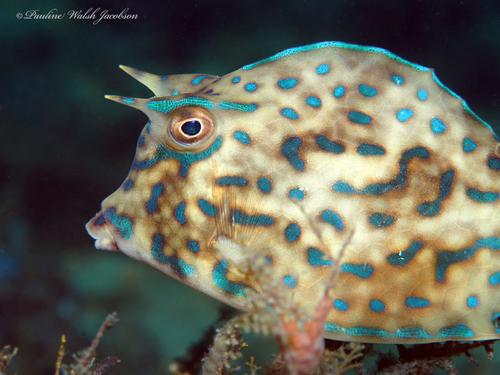
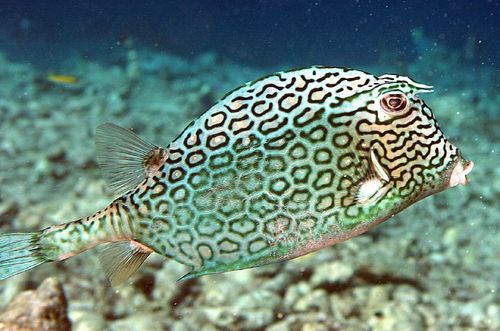
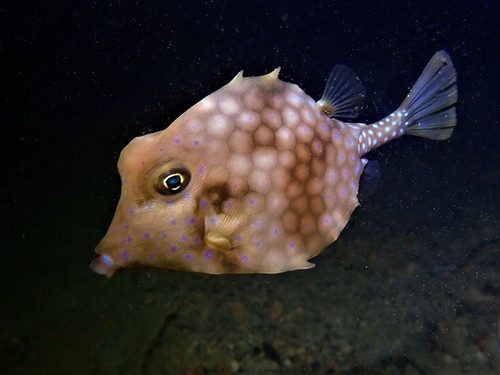
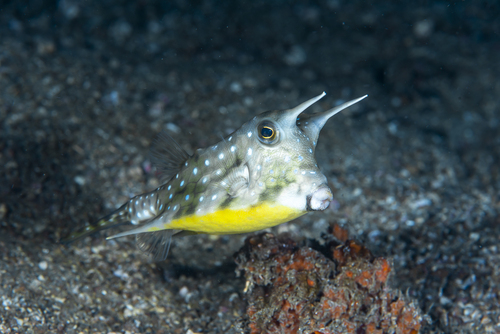
There is no documented sexual dimorphism in Lactoria cornuta, the longhorn cowfish, so both sexes share the same base coloration ranging from yellow to olive, marked with white or bluish spots. Females are generally larger and heavier than males.
Male Size and Weight
Males reach a total length of 65–155 mm, with an average length of 103 mm, and weigh between 12–116 g, with an average weight of 26 g.
Female Size and Weight
Females reach a total length of 83–250 mm, with an average length of 121 mm, and weigh between 17–156 g, with an average weight of 33 g.
Gill Structure
Longhorn cowfish differ from many other fish species in the absence of a gill cover; this structure is replaced by a small slit or hole.
Carapace Structure
Their hexagonal, plate-like scales are fused together into a solid, triangular, box-like carapace, with fins and the tail protruding out from this structure.
Head Features
They have large eyes positioned immediately behind their characteristic head horns.
Swimming Method
This species swims using a unique method known as ostraciiform swimming, which gives the fish the appearance of hovering.
Pelvic Fin Absence
They have no pelvic skeleton, and therefore lack pelvic fins.
Tail Fin Characteristics
Their tail fin can grow to the same length as their entire body, as the species relies entirely on its fins for movement.
Defensive and Behavioral Traits
Longhorn cowfish are slow swimmers that can easily be caught by hand, and they make a grunting noise when captured. This species can produce two distinct types of sound—hums and clicks—using muscles connected to its swim bladder.
Aquarium Trade Status
It is the most widely well-known cowfish species kept in the aquarium trade.
Habitat Type
The primary habitat of Lactoria cornuta is coral reefs located in lagoons, reef flats, estuaries, bays, and protected seaward reefs. Juvenile individuals associate with Acropora corals.
Depth Range
This species typically occurs at depths between 1 m and 45 m (3 ft 3 in to 147 ft 8 in), and may be found as deep as 100 m (330 ft).
Core Distribution
The natural distribution of Lactoria cornuta extends from the Red Sea and East Africa eastward through Indonesia to the Marquesas, and northward to southern Japan. It is also found in the Tuamotus, southern Korea, the Ryukyu Islands of southern Japan, and south to Australia and Lord Howe Island, occupying tropical and subtropical waters.
New Occurrence in India
Records of specimens found in India represent a new occurrence developed in recent years; it is speculated that cyclones or typhoons carried the species to this new environment.
Reproductive Harem Structure
During reproduction, this species forms harems, each containing 3–4 females.
Spawning Timing
Females spawn shortly after sunset, or during the day when there is extensive cloud cover. The spawning season runs from February to early October.
Courtship and Early Life Stage Dispersal
Paired courtship occurs just before or after sunset. Both eggs and ichthyoplankton are pelagic.
Egg and Larval Development
For species within the genus Lactoria, oval eggs hatch into juvenile larvae. These larvae are distinct because they develop the boxy carapace armor that characterizes adult longhorn cowfish.
Local Cultural Tradition
On Pamban Island, local tradition holds that when the island became separated from the mainland, the cows living on the island metamorphosed into these fish, which then feed on seaweed.