About Acanthostracion polygonius Poey, 1876
Species Identification
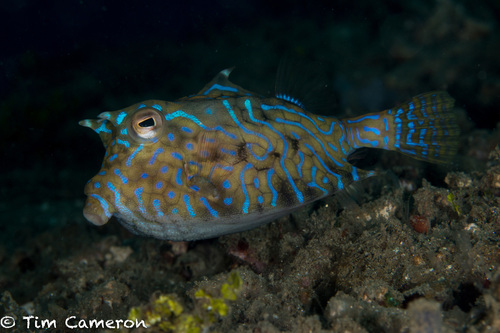
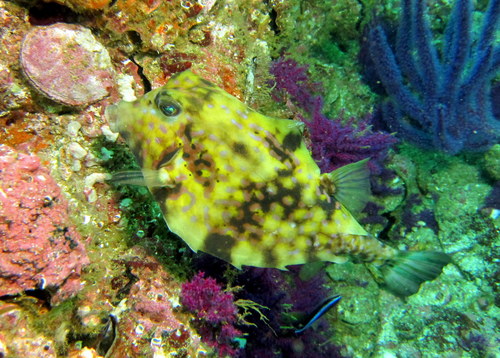
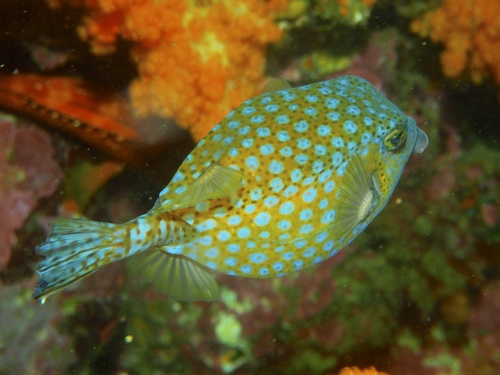
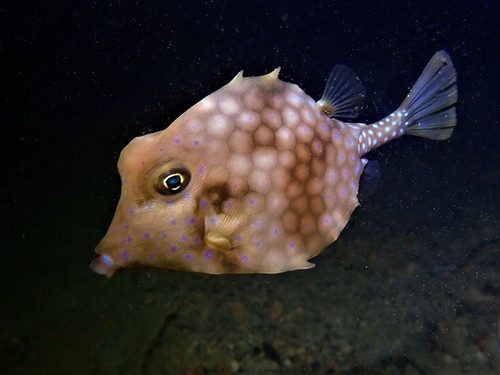
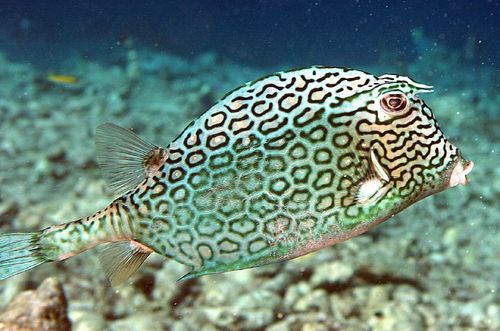
The honeycomb cowfish, Acanthostracion polygonius, has armor-like hexagonal scales covering most of its body.
Etymology and Camouflage
It gets its name from its distinctive honeycomb-like body pattern and prominent "horns"; this pattern helps the fish blend into surrounding coral reefs.
Adult Coloration
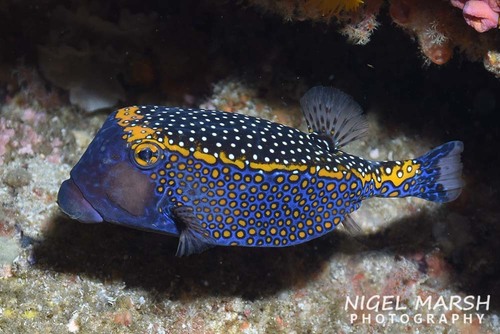
Most individuals are blue, but they may also appear yellow, gray, or green.
Juvenile Coloration
Juveniles are typically more colorful than adult fish.
Fin Structure
This species lacks pelvic fins, and has a rounded caudal fin.
Horn Structure and Function
Several of the honeycomb cowfish's modified bony scales form its "horns", which act as a protective feature.
Distinguishing Morphological Features
It can be told apart from similar fish by the two spines above its eyes and its characteristic hexagonal body pattern.
Mouth Morphology
Compared to other boxfish, the honeycomb cowfish has a smaller protruding mouth and fleshy lips.
Size Measurements
Its maximum recorded body length is 50 centimeters, while the average length is 25 centimeters.
Broad Geographic Range
This species is distributed across the western Atlantic Ocean, the Caribbean Sea, and waters adjacent to Brazil.
Gulf of Mexico Distribution
It is absent from most of the Gulf of Mexico, but has established populations around Florida.
Habitat Preferences
The honeycomb cowfish inhabits warm, clear waters near coral reefs, seagrass beds, and in estuaries.
Population Characteristics
It is an uncommon and cautious species.
Food Fish Value
Honeycomb cowfish are valued as food fish, sold fresh and highly prized in the Caribbean where the species is abundant.
Consumption Risks
There have been multiple reported cases of ciguatera poisoning linked to consuming this fish.
Aquarium Trade Use
It is also commercially sold for use as an aquarium fish.