About Lactophrys bicaudalis (Linnaeus, 1758)
Boxfish Family Common Name Origin
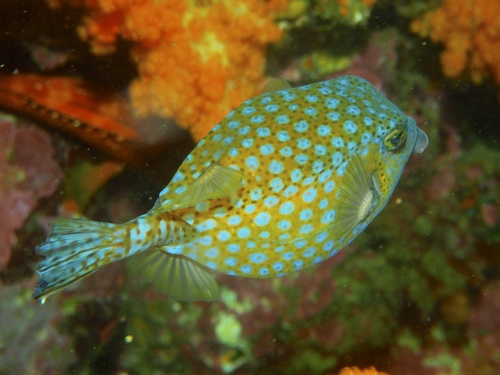
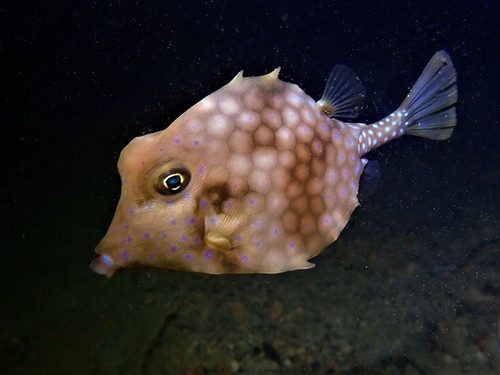
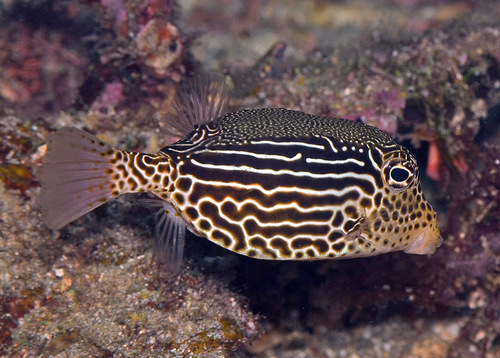
Members of the boxfish family get their common name from a hard outer covering made of fused hexagonal plate-like scales that form a solid, triangular or box-shaped carapace. The eyes, snout, fins, and tail all protrude out from this rigid carapace.
Spotted Trunkfish Base Coloration
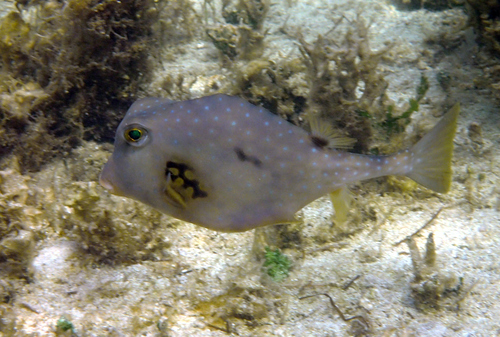
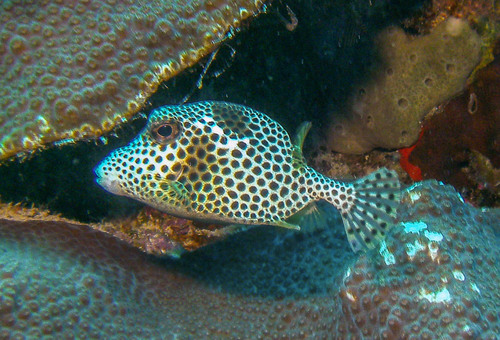
The spotted trunkfish, Lactophrys bicaudalis, has a base body color that is generally white or yellowish, covered with a regular pattern of many black spots across its body and tailfin. Adult individuals have a diagonal row of three white spots just behind the eye, in positions that would normally hold black spots matching the rest of the pattern.
Spotted Trunkfish Head & Spine Features
Its snout is solid plain white, it has no spines above the eye, and it has a pair of sharp spines located in front of the anal fin.
Spotted Trunkfish Geographic Range
The spotted trunkfish occurs in the Caribbean Sea, the southern half of the Gulf of Mexico, around Ascension Island, and along the northeastern coast of South America as far east as Brazil.
Spotted Trunkfish Habitat & Depth
It favors clear water, and is most commonly found associated with coral reefs that have fissures, holes, and overhangs, at depths down to approximately 30 meters (100 feet).
Spotted Trunkfish Locomotion
The heavy armored scales of the spotted trunkfish mean it can usually only move slowly, rippling its dorsal and anal fins while gently beating its pectoral fins to propel itself. When it needs to move faster, it can also use its tail fin for additional propulsion.
Spotted Trunkfish Feeding & Diet
It is a benthic species that feeds on or near the seabed. Its diet includes crabs, shrimps, molluscs, sea urchins, starfish, brittle stars, sea cucumbers, tunicates, and seagrasses.
Spotted Trunkfish Toxin Secretion
Like all trunkfish in the genus Lactophrys, the spotted trunkfish secretes a colorless toxin from glands in its skin when it is touched. This toxin is only dangerous if ingested, so it causes no immediate harm to divers. Predators as large as nurse sharks can die after eating a spotted trunkfish.