About Ostracion meleagris Shaw, 1796
Taxonomy and Body Shape
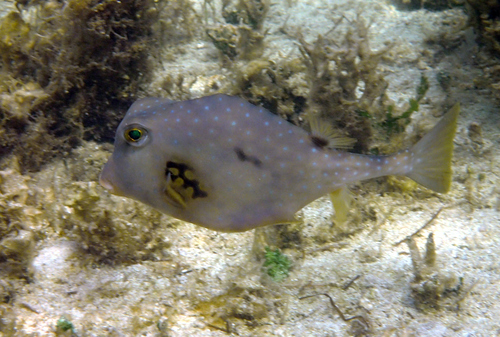
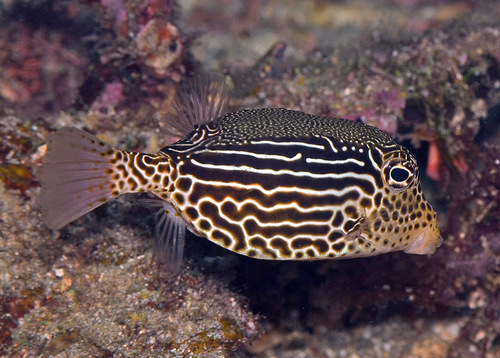
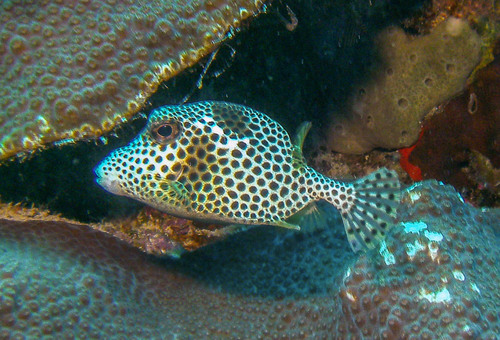
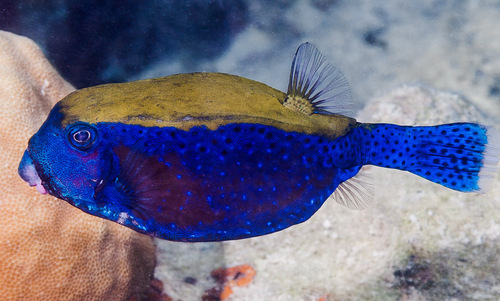
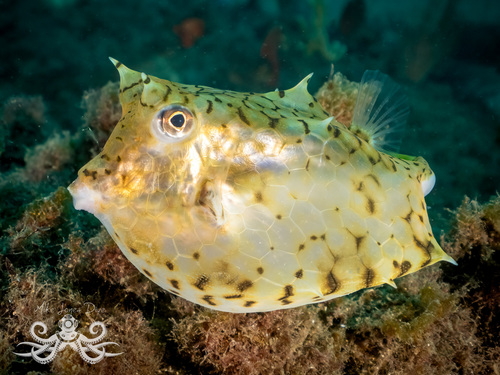
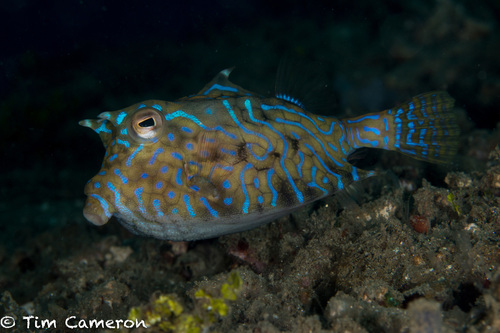
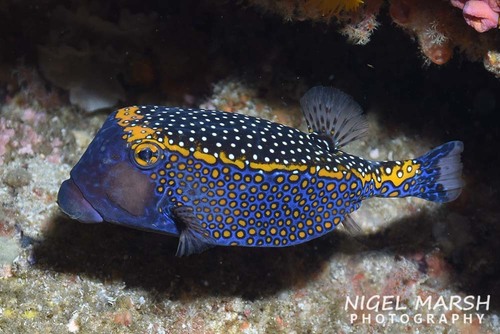
The spotted boxfish, Ostracion meleagris Shaw, 1796, has an oblong, thick body fully enclosed in a bony box. This box is formed from thickened, fused, enlarged hexagonal scale plates, with openings only for the mouth, eyes, gill slits, fins, and tail base.
Body Ridges and Spines
The species has a slightly rounded back, a pair of longitudinal ridges on its lower flanks, a flat ventral surface, and no spines.
Mouth and Teeth
Its small mouth sits at the front of the body, has fleshy lips, and holds 15 mid-sized teeth on each jaw.
Gill Openings
Gill openings are short, forming oblique slits in front of the pectoral fin base.
Fin Structure
Both the anal and dorsal fins are positioned at the rear of the body; the dorsal fin has no spines, the caudal fin is rounded, and pelvic fins are entirely absent.
Juvenile Coloration
No juvenile spotted boxfish with male coloration or patterning have ever been observed. This suggests either juvenile males are born with female coloration, or all juveniles are born female and change sex later in life.
Diet
The diet of the spotted boxfish includes sponges, worms, tunicates, and other small invertebrates.
Mating Sound Production
Spotted boxfish produce sounds during mating behavior. When mating, one or both individuals produce a low-pitched hum that lasts approximately 6 seconds.
Male-Male Aggression
If a second male arrives after the initial mating to attempt spawning with the female or disrupt the ongoing process, the two males will fight. These fights sometimes produce an audible thump, and the males also produce a short buzzing sound.
Toxic Skin Mucus
This species is covered in a protective toxic slime that can kill other fish, so it is not suitable for keeping in aquariums.
Adult Habitat and Range
Adult spotted boxfish live primarily in the Indo-Pacific Ocean, where they occupy both seaward and protected reefs.
Juvenile Habitat
Juveniles most often find shelter between the long spines of tropical sea urchins anchored to rocks.
Mating Timing
Ichthyologist Phillip Lobel documented that spotted boxfish mate during the afternoon and early evening.
Social Group Structure
Members of this species usually travel in groups made up of one male and multiple females.
Mating Initiation
Mating begins when the male nudges and circles a single female.
Spawning Ascent
If the female responds, the pair swims side-by-side upward to at least 6 feet off the seafloor, led by the male.
Gamete Release
They remain in this side-by-side position with their tails touching and heads slightly separated as both release their gametes (mature haploid germ cells that unite during sexual reproduction).
Post-Spawning Behavior
After releasing gametes, the pair swims back down to the seafloor together.
Post-Spawning Male Aggression
This completed initial spawning event attracts other males to the female, which may attempt to disrupt the process or mate with her instead, making fights between male spotted boxfish very common.