About Kalopanax septemlobus (Thunb.) Koidz.
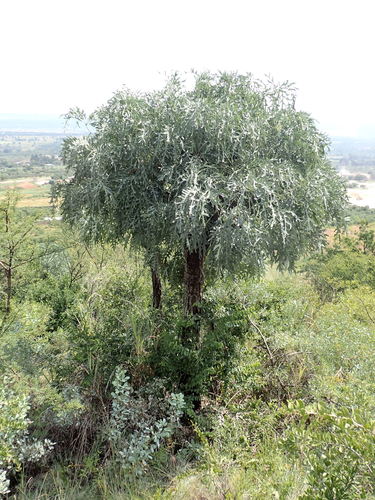
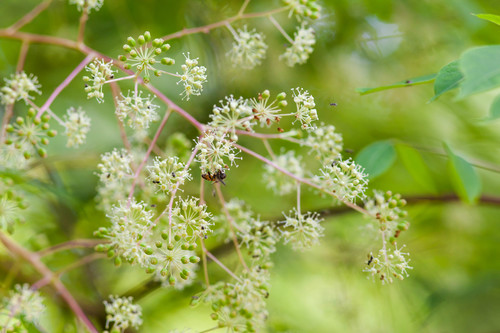
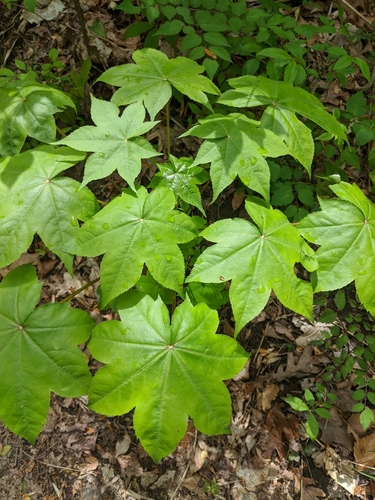
Kalopanax septemlobus (Thunb.) Koidz. is a deciduous tree that reaches up to 30 metres (98 ft) in height, with a trunk between 1–1.5 metres (3.3–4.9 ft) in diameter. Its stems often bear stout spines that grow up to 1 centimetre (0.39 in) long. The leaves are arranged alternately, and look similar to large leaves of Fatsia or Liquidambar (sweetgum). They measure 15–35 centimetres (5.9–13.8 in) across, are palmately shaped with five or seven lobes, and each lobe has a finely toothed margin. Leaf lobes vary widely in shape, ranging from shallowly lobed to cut almost all the way to the leaf base. Trees with deeply lobed leaves were previously classified as the separate variety K. septemlobus var. maximowiczii, but because the variation in leaf shape is continuous and not linked to geography, this variety is no longer recognized as distinct. The species produces flowers in late summer; the flowers are borne in large umbels 20–50 centimetres (7.9–19.7 in) across at the tip of a stem, and each individual flower has 4–5 small white petals. The fruit is a small black drupe that holds two seeds. The tree is grown as an ornamental in Europe and North America, valued for the tropical appearance of its large palmate leaves. Despite its tropical-looking foliage, it is extremely hardy, able to tolerate temperatures as low as at least −40 °C (−40 °F). It grows very quickly when young, but its growth rate slows once it reaches around 40 years of age. This tree has been found growing wild in multiple U.S. states, including New Hampshire, Connecticut, and Maryland. It is considered a species of concern by the U.S. National Park Service and the Maryland Department of Natural Resources. In Korea, the young shoots of this tree, called eumnamu-sun, are commonly eaten as sukhoe, a blanched dish.