About Aralia spinosa L.
Basic Growth Form
Aralia spinosa L. is an aromatic, spiny deciduous shrub or small tree that grows 2–8 m (7–26 ft) tall. It typically has a simple or occasionally branched stem, with very large bipinnate leaves 70–120 cm (30–45 in) long.
Trunk and Canopy
Trunks can reach up to 15–20 cm (6–8 in) in diameter, and mature plants form an umbrella-like canopy with an open crown. Young stems are stout and densely covered in sharp spines, and the species most often grows in clusters of branchless trunks, though stout, wide-spreading branches may occasionally develop.
Flower Characteristics
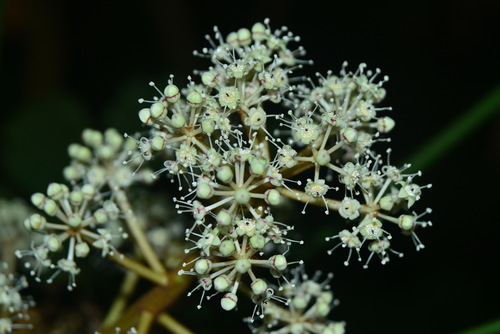
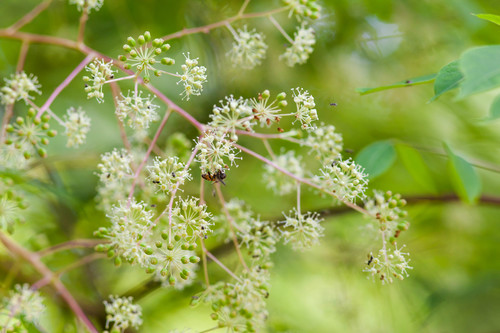
Its flowers are creamy-white; each individual flower is small, around 5 mm (3⁄16 in) across, but they are produced in large composite panicles 30–60 cm (12–24 in) long. Flowering occurs in late summer.
Fruit and Roots
The fruit is a purplish-black berry 6–8 mm (1⁄4–5⁄16 in) in diameter that ripens in fall. Roots are thick and fleshy.
Leaf Size
Its double or triple compound leaves are the largest of any temperate tree in the continental United States; individual leaves can reach about 1 m (3.3 ft) long and 76 cm (2.5 ft) wide, with 5–8 cm (2–3 in) long leaflets. Petioles are prickly with swollen bases.
Autumn Foliage
In autumn, leaves turn a distinctive bronze red tinged with yellow, making the species conspicuous and attractive.
Distinctive Growth Appearance
The growth habit and general appearance of Aralia spinosa and related tree-forming Aralia species are unique. It usually occurs as a group of unbranched stems that reach 3.5–6 m (11–20 ft) tall, with a crowded cluster of double or triple compound leaves forming their canopies, giving each stem a tropical palm-like appearance.
Southern Range Height
In the southern part of its range, it is reported to reach 15 m (50 ft) tall while still retaining this palm-like form.
Northern Growth Form
Further north, the slender, swaying palm-like appearance is most characteristic of younger plants that have not been damaged by winter storms.
Bark Features
The bark is light brown, divided into rounded, broken ridges.
Branchlet Characteristics
Branchlets are 1.3–1.7 cm (one-half to two-thirds of an inch) in diameter, armed with scattered stout, straight or curved prickles, and almost completely encircled by narrow leaf scars. Young branchlets are light yellow brown, shining, and dotted, maturing to light brown.
Wood Properties
The wood is brown with yellow streaks, light, soft, brittle, and close-grained.
Winter Buds
Winter buds have a terminal bud that is chestnut brown, 1.3–1.9 cm (one-half to three-fourths of an inch) long, conical, and blunt; axillary buds are flattened, triangular, and 0.6 cm (one-fourth of an inch) long.
Leaf Arrangement and Structure
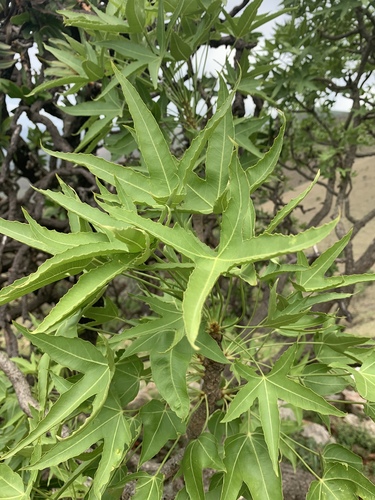
Leaves are clustered at the ends of branches, compound, bi- and tri-pinnate, 90–120 cm (three to four feet) long and 76 cm (two and a half feet) broad. Pinnae are unequally pinnate, with five or six pairs of leaflets plus a long-stalked terminal leaflet, and these leaflets are often themselves pinnate.
Leaflet Morphology
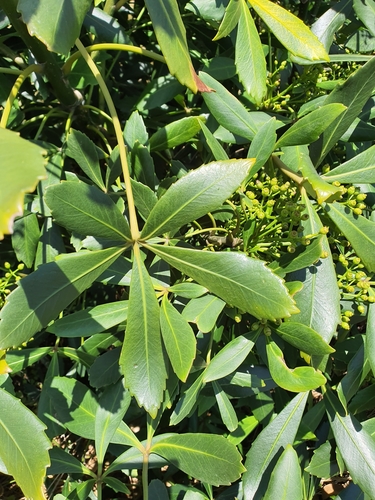
The final leaflets are ovate, 5–8 cm (two to three inches) long, wedge-shaped or rounded at the base, serrate or dentate, and acute. The midrib and primary veins are prominent.
Leaf Coloration
Newly emerged leaves are bronze green, shining, and somewhat hairy; when fully grown, leaves are dark green above and pale beneath. Midribs frequently have prickles.
Petiole and Stipule Features
Petioles are stout, light brown, 46–51 cm (eighteen to twenty inches) long, clasping, and armed with prickles. Stipules are acute and 1.3 cm (one-half inch) long.
Flowering Period
Flowers bloom in July and August.
Flower Reproductive Features
They are perfect or polygamomonoecious, cream white, and borne in many-flowered umbels arranged in compound panicles. They form a terminal racemose cluster 90–120 cm (three to four feet) long that rises alone or in groups of two to three above the spreading leaves.
Flower Bracts and Calyx
Bracts and bractlets are lanceolate, acute, and persistent. The calyx tube is coherent with the ovary and has minute five-toothed edges.
Corolla Structure
The corolla has five white petals inserted on the margin of the disk, acute, slightly inflexed at the apex, and imbricate in bud.
Stamen Characteristics
There are five stamens inserted on the margin of the disk, alternating with the petals; filaments are thread-like, anthers are oblong, attached to the back, introrse, and two-celled, with cells that open longitudinally.
Pistil Structure
The pistil has an inferior, five-celled ovary with connivent carpels and a capitate stigma.
Mature Fruit Features
The fruit is a berry-like drupe, globular, black, 0.6 cm (one-fourth of an inch) long, five-angled, and crowned with blackened styles, with thin, dark flesh.
Species Distribution
Aralia spinosa is widespread in the eastern United States, ranging along the Atlantic coast from New York to Florida, and westward to Ohio, Illinois, and Texas.
Habitat Preferences
It prefers deep, moist soil, and typically grows in forest understories or at forest edges. It often forms clonal thickets by sprouting from its roots.
Iroquois Ethnobotany
The Iroquois admired this tree for its usefulness and rarity; they would transplant its saplings to grow near their villages and on islands to keep animals from eating its valuable fruit, and used the fruit in many of their foods. Iroquois women placed the flowers in their hair for their lemony scent, and the flowers could also be traded for money.
Historical Taxonomic Confusion
In the past, botanists considered Aralia populations north of Maryland and Delaware in the Mid-Atlantic states to be introduced Aralia spinosa from southern areas. However, many of these populations are now known to be Aralia elata, a related invasive Asian species.
Invasive Species Threat
A. spinosa and A. elata are difficult to distinguish in the field, leading to confusion between the two, and A. elata is displacing A. spinosa in at least one area of Philadelphia, with unknown impacts on local ecology.
Edible Uses
Young leaves can be eaten if collected before the prickles harden; they are chopped finely and cooked as a potherb.
Cultivation History
Aralia spinosa was introduced to cultivation in 1688, and is still grown for its decorative foliage, prickly stems, large showy flower panicles, and distinctive fall color.
Cultivation Traits
Plants are slow growing, tough, durable, and grow well in urban settings, but bear numerous prickles on their stems, petioles, and leaflets. They can be propagated from seeds or root cuttings.
Historical Medicinal Uses
Early American settlers used the plant for its supposed ability to cure toothaches, and it was used as a medicine during the American Civil War.
Antimicrobial Properties
Laboratory tests have found that extracts from the plant show antimicrobial activity against multidrug-resistant bacteria associated with wound infections.