About Justicia purpusii (Brandegee) D.N.Gibson
Taxon Identity
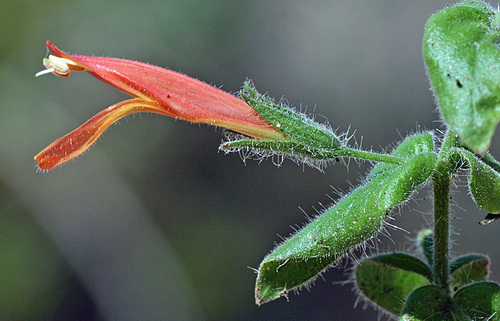
Justicia purpusii (Brandegee) D.N.Gibson is a shrub that is completely covered in both tomentose and villous hairs.
Foliage Arrangement & Shape
Its foliage is made up of opposite leaves that range in shape from ovate to elliptic, and most of these leaves have entire margins.
Lower Leaf Characteristics
Lower leaves grow 7–8 cm (2.8–3.1 in) long and 4–5 cm (1.6–2.0 in) wide, and attach to the stem via 2 cm (0.79 in) long petioles.
Upper Leaf & Bract Morphology
Upper leaves develop progressively shorter petioles, eventually becoming sessile bracts shaped like cordate to broadly ovate forms. These bracts are wider than they are long, and have a clasping base.
Flower Placement
Flowers grow from the axils of these bracts.
Calyx Structure
The calyx is split into five narrow segments that measure 12–18 mm (0.47–0.71 in) long.
Corolla Structure
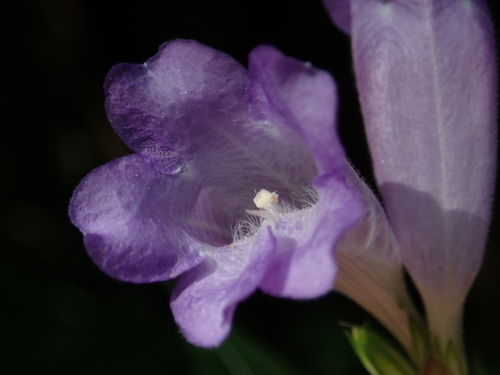
The corolla is 3 cm (1.2 in) long, with an erect upper lip and a three-lobed lower lip.
Seed Characteristics
Its seeds are ash-colored, nearly spherical, and have a rugose texture on their sides.
Interspecific Distinction from Justicia californica
This species can be told apart from its close relative Justicia californica by its flowers growing from larger, persistent bracts and its non-tropical distribution. In contrast, J. californica is restricted to more arid desert climates, has small, unremarkable bracts, and shorter calyx lobes.
Endemic Range
This species is endemic to the Cape region of Baja California Sur, Mexico, which is the southernmost area of the Baja California peninsula.
Habitat & Elevation
It grows in the region's tropical dry forests and thorn scrub, and is typically found in shady canyons and their rocky beds, as well as on wet slopes, steep walls, hillsides, and ridges, at elevations between 250–1,000 m (820–3,280 ft).