About Anisacanthus thurberi (Torr.) A.Gray
Taxonomic Identity and Growth Form
Anisacanthus thurberi (Torr.) A.Gray is an erect, woody shrub that reaches 1 to 2 meters (3 to 7 feet) in height.
Branch and Leaf Characteristics
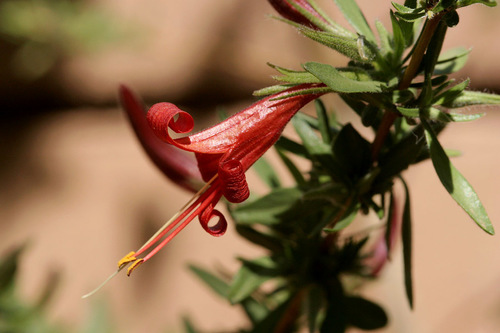
Its spreading branches are covered in pale bark, and bear clusters of small green leaves measuring 4–6 cm long and 1–1.5 cm wide.
Inflorescence and Flower Structure
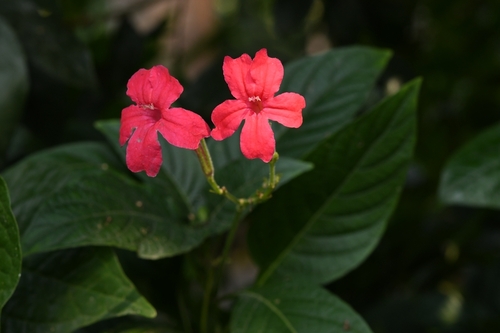
The plant produces inflorescences made of small groups of showy orange or red tubular flowers, which are 2–3.5 cm long. The flowers have a strap-shaped upper lip with one lobe on the upper part and three lobes on the lower part.
Reproductive Floral Parts
Inside each flower are two long, protruding red stamens topped with yellow anthers, plus a longer white style.
Native Range
This species is relatively rare within the United States, and is native only to Arizona, New Mexico, and northern Mexico.
Distribution Details
It occurs across much of Arizona, predominantly in the southern and central regions of the state including the Sonoran Desert, as well as the southwestern corner of New Mexico, and holds large populations in northern Mexico.
Typical Habitat and Elevation
Anisacanthus thurberi most commonly grows in shaded areas of gravelly or sandy washes and rocky canyon bottoms, at elevations between 610 and 1,524 meters (2,000 to 5,000 feet).
Additional Habitat Locations
It can also be found growing on canyon walls and rocky desert hillsides.
Pollination Adaptation
The bright petals and tubular shape of Anisacanthus thurberi's flowers make it well adapted and commonly pollinated by hummingbirds.
Herbivory
It is also frequently browsed by desert herbivores.
Flowering Period
This plant primarily blooms in spring, but can flower year-round if it receives enough rainfall.