About Justicia brandegeeana Wassh. & L.B.Sm.
Taxonomic Identity
Justicia brandegeeana Wassh. & L.B.Sm. is a bushy evergreen shrub that reaches 100 cm (39 in) tall and 60–90 cm (24–35 in) wide.
Foliage Pubescence
Its stems and leaves are covered in soft downy fuzz.
Leaf Arrangement
Leaves are variegated, and typically grow in clusters along branches.
Sun Effect on Leaf Variegation
Increased sun exposure causes the amount of creamy white speckling on leaves to increase, while less sun leads to less creamy white coloration.
Bract Development
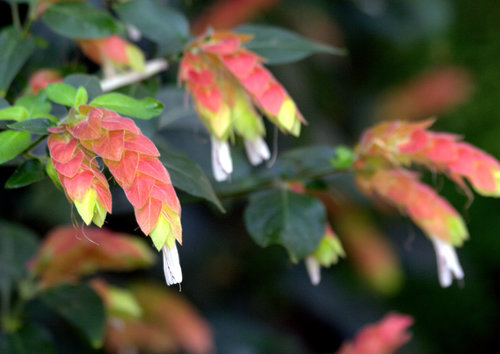
Flowers grow from bracts that form on stems; these bracts start out white, and become pale pink to deep salmon with more sun exposure.
Bract Chain Length
In most cases, chains of bracts continue growing until they fall off, so these chains can range from a few centimetres to almost 30 cm (1 ft) long.
Flower Morphology
Flowers emerge from the bracts; they are usually long, thin, and white, with maroon-speckled throats.
Blooming Pattern
Once blooming begins, it continues for months, stops for a short period, then resumes blooming.
Pollination
Flowers attract both hummingbirds and butterflies, and pollination is most often done by hummingbirds.
Family Classification
This species belongs to the family Acanthaceae, which is part of the major group of flowering plants called Angiosperms.
Genus Context
It is classified in the genus Justicia, which is part of Acanthaceae and contains roughly 600 species.
Justicia Genus Phytochemical Properties
Research on phytochemical components of numerous Justicia species has found that these species have antitumor, antiviral, and antidiabetic activity.
J. brandegeeana Phytochemical Research Status
Until recently, J. brandegeeana was not a subject of this type of phytochemical research.
Tropical Habitat Light Preference
In tropical regions, the shrimp plant (as it is commonly known) grows well in shade.
Soil Preference and Drought Tolerance
It prefers well-drained sandy or loamy soil, but it is generally low maintenance and drought tolerant.
Cold Tolerance and Temperate Cultivation
The species does not tolerate temperatures below 7 °C (45 °F), so in cooler temperate climates it is usually grown under glass.
Houseplant Suitability
It makes an excellent potted houseplant for these areas because it can tolerate low light and some degree of neglect, and it does not require fertilization.
Unpruned Growth Habit
Unpruned, the plant usually has a long, spindly shape.
Trimming Effect on Growth Habit
Regular trimming encourages a bushy habit that does not need extra support.
Unpruned Branch Support
If branches are allowed to grow long, they cannot support their own weight and will sag toward the ground.
Cultivar Variety
Many cultivars are available with different colored flower bracts, including yellow, pink, and dark brick-red.
Propagation and Horticultural Award
This plant can be propagated from stem cuttings, and has received the Royal Horticultural Society's Award of Garden Merit.
Unpruned Size
Without regular trimming, Justicia brandegeeana can become a messy shrub, and unpruned plants can grow over 24 inches tall.
Trimming Requirement
To maintain its shape and keep it at a desirable size, it needs annual trimming.
Lifespan
This shrub has an expected lifespan of 10 to 20 years.