About Isopogon sphaerocephalus Lindl.
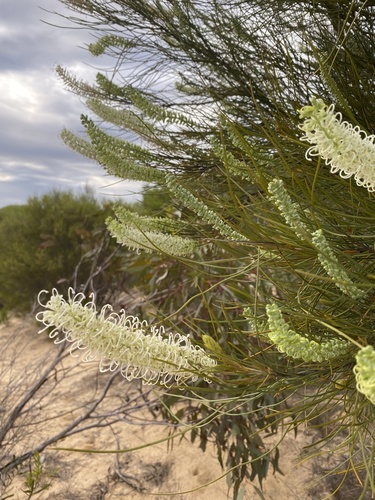
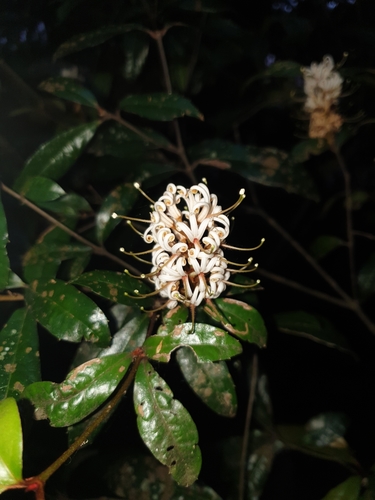
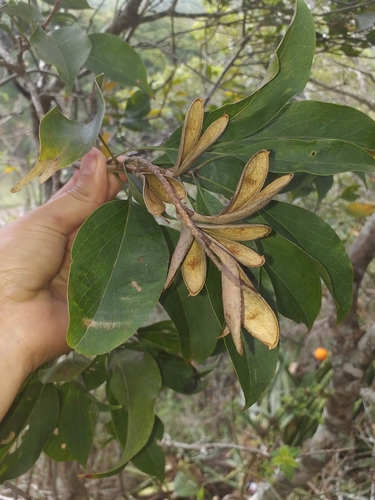
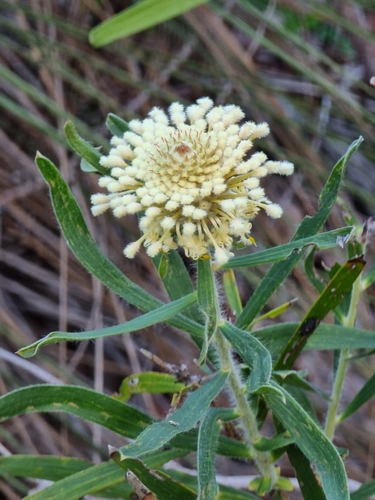
Isopogon sphaerocephalus is a shrub that usually grows between 0.3 and 2 meters (1 foot 0 inch to 6 feet 7 inches) in height. It has hairy brownish new branchlets, as well as hairy young leaves. Its mature leaves are linear to egg-shaped with the narrower end at the base, 50 to 160 millimeters (2.0 to 6.3 inches) long, 4 to 18 millimeters (0.16 to 0.71 inches) wide, and end in a small sharp point. Flowers form at the ends of branchlets in sessile, spherical flower heads 25 to 30 millimeters (0.98 to 1.18 inches) in diameter. These flower heads have hairy, egg-shaped involucral bracts at their base. Individual flowers are densely hairy, white to pale or creamy yellow, and reach up to 15 millimeters (0.59 inches) in length. Flowering takes place from July to January. After flowering, the plant produces hairy nut fruits, which are fused together into a conical to oblong head 20 to 30 millimeters (0.79 to 1.18 inches) in diameter. There are two recognized subspecies with different distributions and habitats. Subspecies sphaerocephalus grows in jarrah forest between Gidgegannup, the Scott River area, and the Kent River, located within the Jarrah Forest, Mallee, Swan Coastal Plain, and Warren biogeographic regions. Subspecies lesueurensis grows in shrubland on and near the slopes and bases of hills in the Mount Lesueur area.