About Persoonia falcata R.Br.
Growth Form
Persoonia falcata R.Br. grows as a woody shrub or small tree, reaching 1 to 9 metres (3.3 to 29.5 feet) in height.
Bark Characteristics
It has thick, dark grey, layered and flaky bark.
Leaf Features
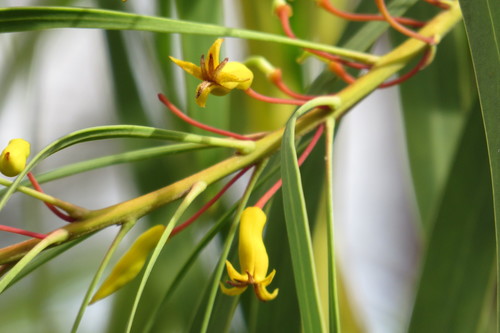
Its pale green-grey leaves are 8–35 cm (3.1–13.8 in) long and 0.4–3 cm (0.16–1.18 in) wide, shaped as oblanceolate, linear-oblanceolate, or falcate.
Flowering Period
Yellow flowers bloom between June and November.
Fruit Traits
The plant produces yellow-green drupe fruits, which ripen from October to February.
Traditional Fruit Use
The fruits are edible and are eaten raw by local Aboriginal people.
Overall Distribution Range
This species is distributed across a wide area of northern Australia, generally found within 300 km (190 mi) of the coast.
Geographic Range Boundaries
In northwestern Western Australia, it occurs in the Great Sandy Desert and the area around Broome, extending east through the Northern Territory into northern Queensland, with the Blackdown Tableland as its southeastern range limit.
Habitat Types
It grows along watercourses, in gorges, and on sandstone outcrops, most commonly on sandstone-based or alluvial soils.
Soil Preferences
It can also grow on granite-based and lateritic soils, and rarely occurs on clay.
Associated Plant Communities
It grows in Eucalyptus, Melaleuca, or mixed open woodland communities.
Cultivation Attempt Outcomes
Attempts to cultivate Persoonia falcata at the Royal Botanic Gardens of Sydney and Melbourne have failed; all plants planted into soil have died.
Traditional Ophthalmic Use
Aboriginal people use a solution infused with this plant's wood and bark as an eye wash.
Additional Traditional Uses
They also drink an infusion made from its leaves to treat chest colds and diarrhoea, and apply the leaves directly to circumcision wounds.