About Indigofera australis Willd.
Growth Habit
Indigofera australis Willd. has an upright natural growth habit, reaching up to 2 meters (7 feet) tall, with flexible stems.
Leaf Characteristics
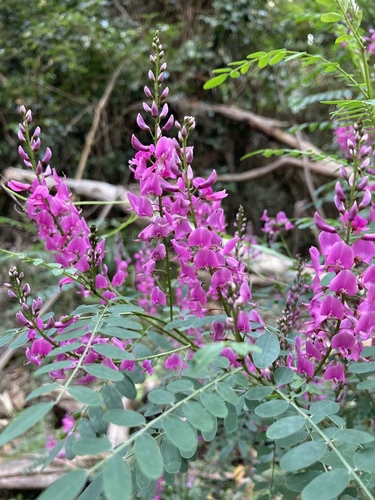
Its leaves are pinnate, openly spaced along the stems, around 10 centimeters long, and have a velvety smooth texture.
Flower Coloration
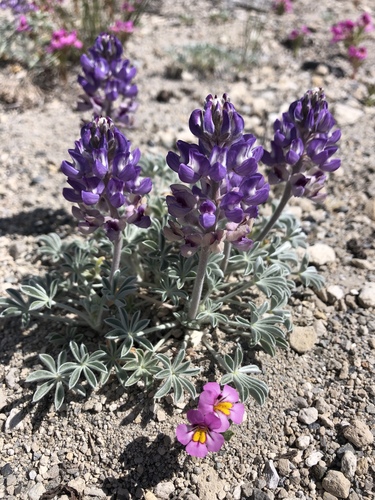
Flower color is unusual, ranging through soft purple hues that are often pinkish, which sets it apart from other species that flower at the same time.
Flower Structure
The smooth flowers grow in short spires in the leaf axils; they are produced freely and are showy, outlining the curves of the stems.
Flowering Period
Flowering can open as early as July and continue through November in a cool spring.
Post-Fire Regeneration
This species can regrow and sucker from rootstocks and lateral roots after fire.
General Distribution
Indigofera australis is a very common and widespread species in Australia, growing in a wide range of different habitats.
Habitat Types
It occurs mainly in open woodland and eucalypt forest, but can also be found in desert and on the margins of rainforest.
Geographic Range
It is widespread across southern Australia, ranging from southeastern Western Australia to northeastern Queensland.
Wildlife Habitat Value
This species provides excellent habitat value for wildlife.
Nitrogen Fixation Trait
Like many plants in the pea family, Indigofera australis is nitrogen fixing.
Insect Food Source
Its flowers are a source of pollen and nectar for many native insects, including bees and wasps.
Butterfly Larval Host Plant
It is also a useful food plant for the larvae (caterpillars) of several butterfly species: Freyeria trochylus (Grass Jewel), Eurema hecabe (Common Grass Yellow), Lampides boeticus (Long-tailed Pea Blue), and Zizina labradus (Common Grass-blue).
Ornamental Use
Its attractive flowers and ability to adapt to growth in different situations make it suitable for use as an ornamental plant in Australia, though it may become invasive.
Traditional Fish Poison Use
First Nations Australians are recorded to crush its leaves and add them to water to kill or stun fish and eels.
Dye Production
The leaves and stems produce a yellow-fawn dye when alum is used as a mordant.