About Ictidomys mexicanus (Erxleben, 1777)
Taxonomy and Basic Classification
The Mexican ground squirrel, scientifically named Ictidomys mexicanus (Erxleben, 1777), is a small to medium-sized rodent.
Distinctive Physical Markings
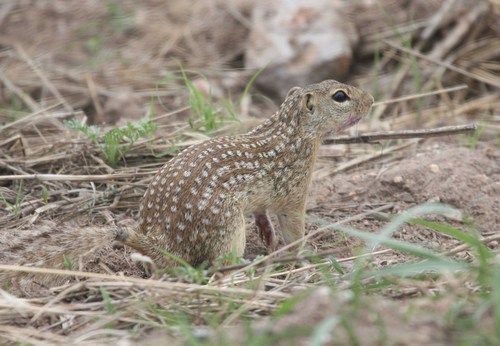
It has nine rows of white spots on its back, small white circles of fur around its eyes, and small ears.
Size and Sexual Dimorphism
Adults reach about fifteen inches in total length, and males are larger than females.
Geographical Distribution
This species is distributed across northern Mexico, the Texas Gulf Coast, western and central Texas, and southeastern New Mexico.
Natural Habitat Preferences
It inhabits flat, brushy, or grassy areas, and typically prefers locations with gravelly or sandy soil, or areas that contain mesquite.
Adaptation to Human-Altered Environments
Although much of its original habitat has been destroyed by human activity, it has adapted well to human settlements and can now be found on golf courses, along highway shoulders, and other similar grassy areas.
Burrow Structure
Each Mexican ground squirrel usually maintains more than one burrow, and each burrow can have up to five escape tunnels.
Burrow Entrance Characteristics
These tunnels do not have a mound of dirt marking their entrance.
Burrow Internal Features
Most burrows contain a grass-lined sleeping chamber for young squirrels.
Mating Season Timing
The mating season of the Mexican ground squirrel runs from April to mid-July, peaking in May.
Female Mating Eligibility
Females are able to mate after their first hibernation season.
Hibernation Behavior
While most Mexican ground squirrels hibernate, some individuals have been recorded not hibernating.
Social Behavior Outside Mating Season
This species is normally solitary, but individuals gather in groups during the mating season.
Mating Season Social Dynamics
During this period, changes in female hormone levels allow groups to form without aggression.
Nest Preparation for Breeding
When mating season begins, the female prepares a nesting chamber inside her burrow, lining it with mesquite and grass.
Litter Size Range
The average litter size is five, though litters can range from one to ten individuals.
Juvenile Development and Dispersal
Young are born toothless and hairless, and remain with their mother for three months before dispersing to live independently.