About Marmota olympus (Merriam, 1898)
Head and Body Morphology
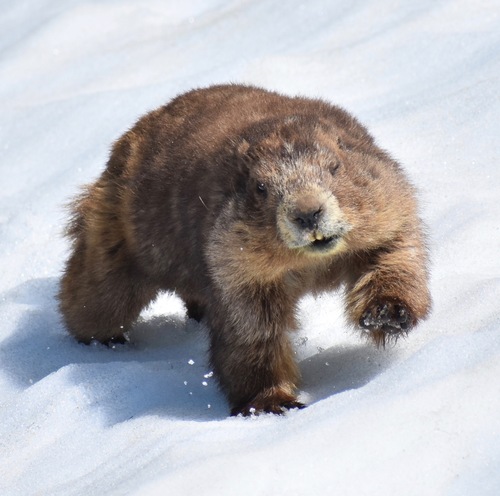
Description: The Olympic marmot (Marmota olympus) has a wide head with small eyes and ears, a stocky body, stubby legs, and sharp, rounded claws that help with digging.
Tail Size
Its bushy tail measures 18 to 24 cm (7.1 to 9.4 in) long.
Body Length and Weight Range
This species is roughly the size of a domestic cat; adult total length ranges from 67 to 75 cm (26 to 30 in), with an average of 71 cm (28 in), and adult weight ranges from 2.7 to 11 kg (6.0 to 24.3 lb).
Sexual Dimorphism
This marmot may have the most pronounced sexual dimorphism among all marmots. In spring after emerging from hibernation, adult males average 4.1 kg, while they reach an average peak weight of 9.3 kg in autumn; at the same time points, adult females weigh 3.1 to 7.1 kg (6.8 to 15.7 lb).
Size Comparison to North American Marmots
The Olympic marmot is the largest of the six marmot species native to North America. Its average body mass is slightly higher than that of the hoary marmot and Vancouver marmot, and on average it is about 7% larger in mean linear dimensions than these two large North American species.
Size Comparison to Global Marmots
It rivals some understudied Asian marmot species as one of the largest marmots and one of the largest members of the squirrel family, reaching body masses similar to species like the Tarbagan marmot and Himalayan marmot.
Coat Structure
Its coat is double-layered, made up of a soft, thick insulating underfur and coarser outer hairs.
Infant and Yearling Fur Color
Infant Olympic marmots have dark gray fur. This color changes to grayish brown with lighter patches when they reach the yearling stage.
Adult Base Fur Color
For most of the year, adult bodies are brown with small white or pale brown patches, and the overall coat darkens as the year goes on.
First Annual Molt Process
The first annual molt begins in June, starting with two black fur patches forming on the back of the shoulders. The black coloration then spreads across the entire body, and the coat becomes almost black by fall.
Second Annual Molt Process
A second molt is thought to happen during hibernation, and when marmots emerge from hibernation in spring, their coats may be tan or yellowish.
Facial Markings
The muzzle is almost always white, with a white white band running in front of the eyes.
Distinguishing Features from Hoary Marmot
This species can be easily told apart from the hoary marmot (which shares almost all of its other physical traits) by its lack of contrasting black feet and a black head spot.
Coat Similarity to Vancouver Island Marmot
Vancouver Island marmots have a similar coat color of chocolate brown with white patches.
Geographic Range
Distribution and habitat: Olympic marmots are native to the Olympic Mountains on the Olympic Peninsula of Washington state.
Park Habitat Distribution
Around 90% of the species' total habitat lies within Olympic National Park, where they are often sighted, especially on Hurricane Hill. Populations are declining in some areas of the park due to tree encroachment on meadows and predation by coyotes, and they are rarely seen in the wetter southwestern part of the park.
Habitat Types
Within the park, Olympic marmots live in lush sub-alpine and alpine meadows, fields, and montane scree slopes.
Colony Structure
They live in scattered colonies across the mountains that hold burrows for varying numbers of marmot families. Some meadows hold only one marmot family, while others hold multiple families totaling up to 40 marmots.
Migration Importance
Meadows with smaller marmot populations carry a higher risk of inbreeding and death from random events, so migration is essential for the species' survival.
Burrow Elevation Range
Marmot burrows are found at elevations ranging from 920 m (3,020 ft) to 1,990 m (6,530 ft), and are most common between 1,500 m (4,900 ft) to 1,750 m (5,740 ft).
Burrow Slope Preference
Burrows are more often located on south-facing slopes, which generally receive more precipitation (75 cm (30 in) per year, mostly as snow) and thus support more abundant flora.
Home Range Size
The home range of a marmot family usually covers between half an acre to five acres (0.2–2 hectares).
Cold Habitat Adaptation
The Olympic marmot is well adapted to its generally cold natural habitat, where snowfall occurs in almost every month of the year on mountain slopes and barren grasslands.
Reproductive Rate
Life cycle: Along with the hoary marmot, the Olympic marmot has the lowest reproductive rate of any rodent.
Litter Characteristics
Females produce a litter of one to six young (averaging 3.3) every other year. In any given year, only one third of females will produce a litter.
Juvenile Survival and Lifespan
Half of all pups die before the following spring. Pups that survive past their first spring can live into their teens.
Sexual Maturity Age
Both males and females reach sexual maturity at three years old, but females generally do not reproduce until they are four and a half years old.
Estrus Timing
Olympic marmots emerge from hibernation in early May, and estrus occurs roughly two weeks later.
Courtship Behavior
After hibernation ends, both males and females use courtship rituals to attract mates. Females that have never produced a litter before tend to be more aggressive, and will chase or start fights with males; females that have already produced young typically greet males with nose-to-nose or nose-to-genital contact, followed shortly by copulation.
Mating Timing and System
This approach is more successful than the aggressive behavior of nulliparous females, and mating takes place between 11 to 20 days after hibernation. Sexual mature Olympic marmots have a polygynous mating system; males usually breed with three or four females each mating season.
Gestation and Birthing
Approximately four weeks after mating, females give birth to their young in a grass-lined underground burrow.
Newborn Characteristics
Newborn pups are blind, hairless, and pink in color. At birth, young show no sexual dimorphism.
Pup Emergence and Weaning
It takes about a month before young Olympic marmots first leave the burrow, which is also around when they begin to be weaned. Even after they are allowed to emerge, the young initially stay close to the burrow, where they can be seen chasing each other and play wrestling.
Juvenile Independence
Within a few weeks of first emerging, the young are fully weaned and can feed on their own. Olympic marmots do not become fully independent from their mothers until they are two years old.
Breeding Female Population Importance
Breeding-age female marmots are extremely important to marmot populations. If a breeding-age female dies, it can take years to replace her, due to the species' maximum litter size of six pups, long maturation period, and high rate of juvenile mortality before reaching maturity.