About Ichthyaetus relictus (Lönnberg, 1931)
Taxonomy and Size
This gull species, scientifically named Ichthyaetus relictus (Lönnberg, 1931), measures 44 to 45 cm in length and has a stocky, thick body.
Non-breeding Adult Plumage
Non-breeding adults have uniformly dark-smudged ear-coverts and hind crown, white-tipped wings, prominent isolated black subterminal markings on outer primaries, and no white leading edge to the outer wing.
Breeding Adult Head Plumage
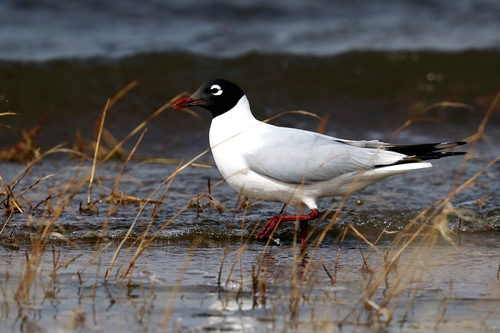
Breeding adults have black hoods that include the napes, with grey-brown foreheads, and broad white half-moon markings behind, below, and above the eyes.
Breeding Adult Soft Parts
Their legs are orange, and their bills are scarlet.
Etymology
The species' common name comes from its status as a relict species.
Breeding Distribution
For distribution and habitat: this gull breeds at several sites in Mongolia (including Galuut Lake, Khukh Lake, and Chukh Lake), two breeding sites in Kazakhstan, one in Russia, and one in China at Lake Hongjiannao.
Non-breeding Distribution
Small numbers are thought to migrate to South Korea during the non-breeding period. There is unconfirmed evidence that larger numbers may also migrate to eastern China.
Breeding Period and Habitat
The gulls breed in colonies on islands in saltwater lakes from early June to early August. These breeding sites are fragile.
Breeding Nesting Conditions
The gulls do not nest if lakes dry up, if water levels are too high, if islands become too small or overgrown with vegetation, or if islands grow so large that they connect to the shore.
Non-breeding Habitat
During the non-breeding period, the gulls live on estuarine mud and sandflats.