About Chroicocephalus hartlaubii (Bruch, 1855)
Taxonomy and Naming
Hartlaub's gull, with the scientific name Chroicocephalus hartlaubii (Bruch, 1855), measures 37–39 cm in length, has a wingspan of 89–92 cm, and weighs 235–340 g.
Adult Plumage
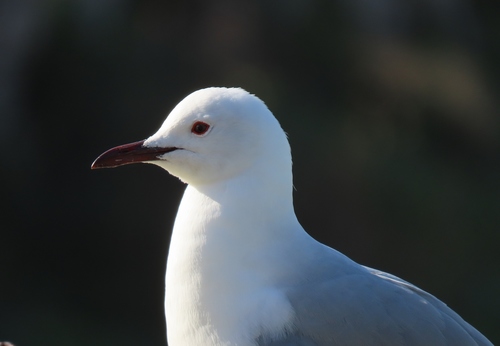
It is a predominantly white gull with a grey back and upperwings, black wingtips with noticeable white "mirrors", and dark red bill and legs. During the breeding season, it develops a very faint lavender grey hood; outside of breeding, its head is plain white. Males and females have similar appearances.
Similar Species Distinction
This species can be distinguished from the slightly larger grey-headed gull by its thinner, darker bill, deeper red legs, paler plainer head, and dark eyes.
Maturation Period
Hartlaub's gull takes two years to reach full maturity.
Juvenile Plumage
Juvenile birds have a brown band across their wings. They differ from juvenile grey-headed gulls in lacking a black terminal tail band, having fewer dark areas on the wings, darker legs, and a white head.
Distribution and Movement
This gull is a non-migratory breeding resident endemic to the Atlantic coastline of South Africa and Namibia.
Habitat
While it is mostly found in coastal or estuarine areas, it is not a pelagic species, and is rarely seen out at sea far from land.
Population Size
Around half of the total current population, estimated at 30,000 individuals, lives in the Greater Cape Town area.
Human Association
The species has adapted well to humans, and can become very tame near settled areas.
Conservation Status
Though it is a relatively rare species — ranking around the tenth rarest among the world's roughly 50 gull species — it is common within its native range.
Human Conflict
In Cape Town, it is widely considered a nuisance: it fouls buildings and bathes in urban ponds, and has sometimes been a hazard to aircraft near airports.