About Hypoplectrus unicolor (Walbaum, 1792)
Body and Head Morphology
Hypoplectrus unicolor has a deep, highly laterally compressed body and head, with a straight forehead, rather short snout, and a protrusible upper jaw. Its preoperculum is angular, with serrations along its edge, and a number of small forward-pointing spines on its lower margin near the angle.
Dorsal Fin Structure
The continuous dorsal fin has ten spines and 14 to 17 soft rays.
Pelvic and Caudal Fin Structure
It has long pelvic fins that extend to or beyond the anus, and the caudal fin is slightly forked.
Body Coloration
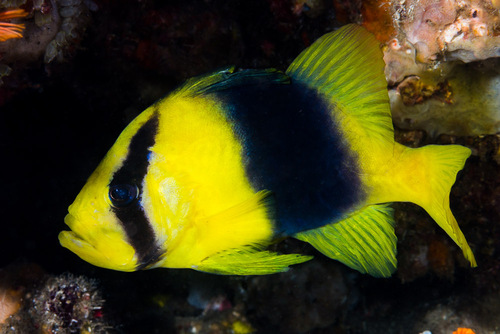
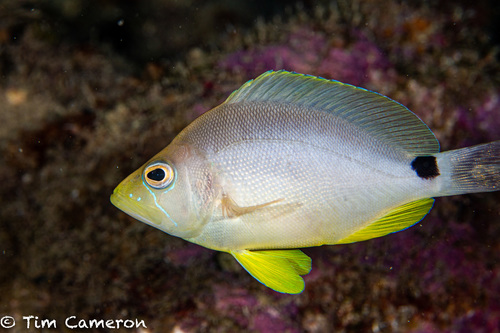
The body ranges in color from greyish white to yellow, with a darker back, and a large black saddle-like marking on the caudal fin base that extends over the lateral line on each side.
Head Markings
Horizontal iridescent blue lines run along the head, and occasionally extend as far as the front edge of the pelvic fins. There is a distinct blue line around the eye, and some individuals may have two black spots on the snout.
Fin Coloration
The pelvic fins are yellowish, while the pectoral fins are transparent.
Maximum Size
This species reaches a maximum total length of 12.7 centimetres (5.0 in).
Geographic Distribution
Hypoplectrus unicolor is distributed in the western Atlantic, ranging from Cape Canaveral in Florida south to the Bahamas, into the Gulf of Mexico as far west as Cedar Key, along the mainland coast of Mexico from Tuxpan to the northern Yucatan Peninsula, and from northwestern Cuba south through the Caribbean Sea.
Habitat Type
This species occurs on shallow fringing reef faces, the front slopes of reefs, and under piers.
Depth Range
It is normally found at depths between 3 and 25 metres (9.8 and 82.0 ft).
Diet Composition
It is a carnivorous species whose diet consists mainly of crustaceans and smaller fishes.
Juvenile Habitat
Juveniles are frequently found in mangroves.
Reproductive Biology
Species in the genus Hypoplectrus are synchronous hermaphrodites, and can switch between "male" and "female" roles when spawning.
Proposed Mimicry Hypothesis
It has been proposed that H. unicolor is a mimic of the foureye butterflyfish (Chaetodon capistratus); this suggestion is based on similarities in color pattern, general body shape, shared use of similar shallow water habitats, the comparative scarcity of H. unicolor, and their differing prey preferences: H. unicolor feeds on mobile benthic animals, while C. capistratus feeds on sessile benthic invertebrates.
Mimicry Counter Evidence
However, H. unicolor varies in color and pattern across its geographic range, while C. capistratus does not, and the juveniles of the two species do not resemble each other.
Interspecific Association Benefit
Even so, there is an association between the two: H. unicolor individuals that follow feeding pairs of C. capistratus have higher prey capture success than hamlets that do not associate with butterflyfish.