About Diploprion bifasciatum Cuvier, 1828
Taxonomic Information
Diploprion bifasciatum Cuvier, 1828 has a compressed, moderately deep body, with a total length 3 to 3.4 times the body depth.
Body Scale Characteristics
Almost all of its body is covered in small ctenoid scales.
Dorsal Fin Structure
The dorsal fin has a deep incision between its spined and soft-rayed sections.
Pelvic Fin Characteristics
It has long pelvic fins that extend past the spiny portion of the anal fin.
Fin Ray Count
The dorsal fin has 8 spines and 13 to 16 soft rays, while the anal fin contains 3 spines and 12 to 13 soft rays.
Adult Coloration
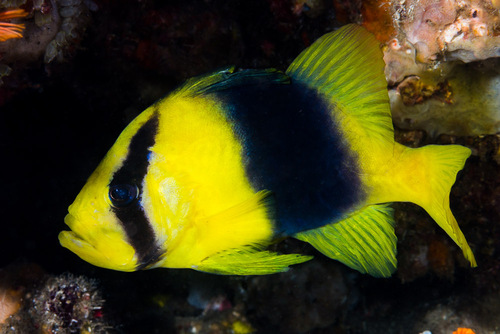
Adults of this species normally range in colour from pale yellow or greyish-yellow to bright yellow, with one dark bar running through the eye and another wider dark band on the posterior part of the body; all fins are yellow.
Large Individual Coloration
Larger individuals can be nearly entirely black, still with yellow fins.
Juvenile Coloration
Small juveniles are bluish on the anterior part of their bodies and yellow on the posterior, and their dorsal fin spiny section is black.
Juvenile Mimicry
Juveniles appear to mimic local venomous blennies of the genus Meiacanthus that are blue or grey in colour.
Maximum Size
This species reaches a maximum total length of 25 centimetres (9.8 in).
Overall Distribution Range
Diploprion bifasciatum has a wide distribution across the Indo-West Pacific.
Extended Geographic Range
Its range extends from the Maldives and India east to Papua New Guinea, the Solomon Islands and New Caledonia, reaching north as far as southern Japan and south to Australia.
Australian Distribution
In Australia, its distribution runs from Rottnest Island in Western Australia to the Solitary Islands Marine Park in New South Wales; juveniles may be found further south, and the species also occurs around Lord Howe Island in the Tasman Sea.
Habitat Preferences
This fish prefers coastal habitats in semi-silty conditions, but also occurs near caves and crevices in rocky and coral reefs.
Depth Range
It lives at depths from 1 to 50 metres (3.3 to 164.0 ft).
Feeding Mechanism
It is a predatory species that can feed on relatively large prey, which it captures and swallows whole using its highly protrusible jaws.
Diet Composition
Stomach content analysis confirms it feeds mainly on fishes and crustaceans.
Stress Response
When stressed, this species secretes the skin toxin grammistin.