About Epinephelus aeneus (Geoffroy Saint-Hilaire, 1817)
Head and Body Proportion
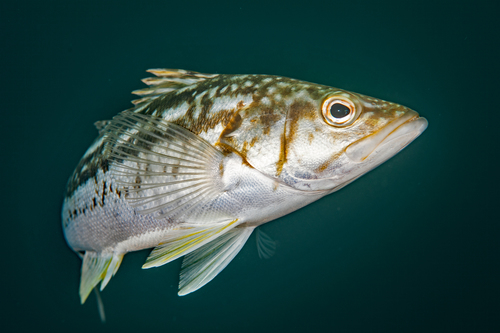
Epinephelus aeneus, commonly known as the white grouper, has a head longer than its body is deep. Its standard length is 3 to 3.6 times the body depth. The dorsal profile is convex between the eyes.
Preopercle Structure
The preopercle is angular, with 3 to 6 large spines at its angle, the lowest of which is directed downwards.
Fin Structure
The dorsal fin has 10-11 spines and 14-16 soft rays, while the anal fin has 3 spines and 7-9 soft rays. The caudal fin is rounded, and the body is covered in small scales embedded in thick skin. There are over 90 scales along the lateral line.
Adult Coloration
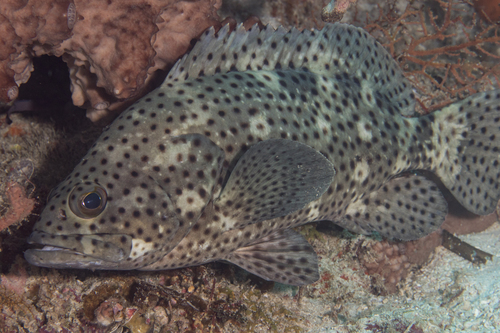
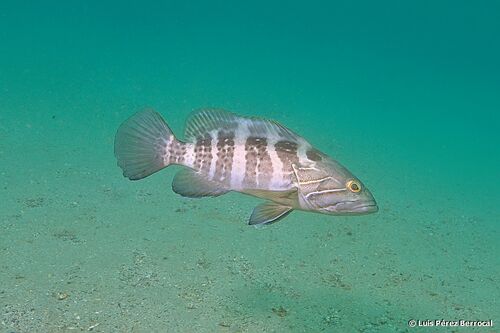
The overall body color is greenish bronze, with darker brownish purple fins that have white or pale margins. 3 or 4 pale blue or white lines cross the gill cover; these lines may be quite faint in larger adults.
Juvenile Coloration
Juveniles have faint dark spots on their bodies that form 5 indistinct dark vertical bars, and also have indistinct dark spots on their fins.
Size and Weight
The maximum recorded total length of this species is 120 centimetres (47 in), though individuals are more commonly around 60 centimetres (24 in), and the maximum published weight is 25 kilograms (55 lb).
Atlantic Distribution
The white grouper is distributed in the eastern Atlantic Ocean, from southern Portugal and southern Spain south along the western African coast to Angola, including the islands of the Gulf of Guinea. Its presence in the Canary Islands and Madeira has not yet been verified.
Mediterranean Distribution
It is found in the southern and eastern Mediterranean, and appears to be expanding its range northwards. It was formerly absent north of 44°N in the Adriatic Sea and absent from the central Mediterranean, but there have been recent records from Corsica and Monaco, among other new northern Mediterranean observations.
Vagrancy Record
This species has a history of vagrancy; the synonym Perca robusta was based on a specimen caught in Cornwall, southwestern England.
Substrate Preference
The white grouper lives on rock, mud, or sand substrates.
Habitat and Depth Range
Juveniles inhabit coastal lagoons and estuaries, while adults are found at depths between 20 and 200 metres (66 and 656 ft).
Diet Composition
This is a carnivorous species. A study off West Africa found that 58% of its diet consists of fish, 21% of stomatopods, 10% of crabs, and 10% of cephalopods.
Seasonal Migration
Off the coasts of Senegal and Mauritania, this species undertakes a seasonal migration linked to coastal upwelling in the region.
Reproductive Biology
It is a protogynous hermaphrodite. Females reach sexual maturity when they grow to a total length of 50 to 60 centimetres (20 to 24 in), at an age of 5 to 7 years. Individuals change sex to male when they reach 10 to 13 years old.
Spawning Periods
Off Tunisia, this species spawns during June and July. In Iskenderun Bay, Turkey, spawning begins in early June and continues through late August.