About Hydropotes inermis Swinhoe, 1870
Basic Species Identity
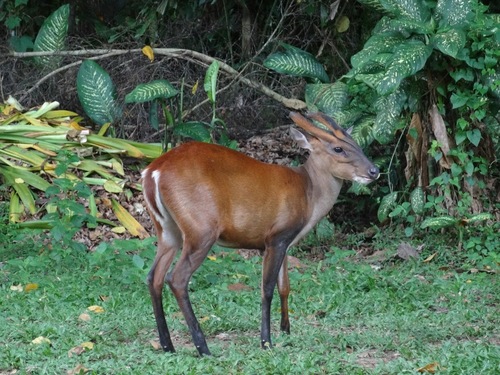
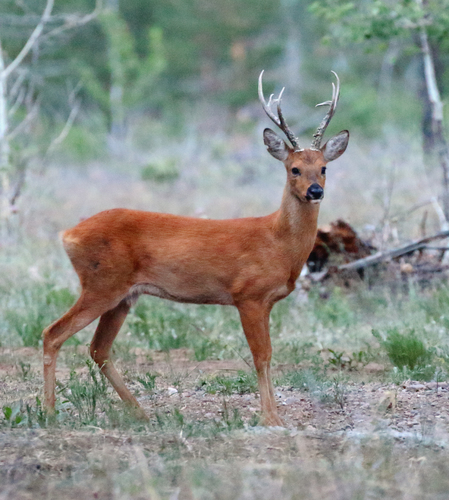
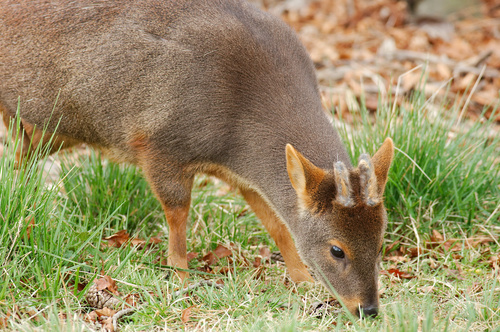
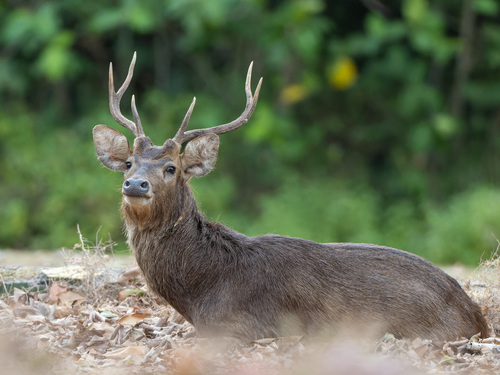
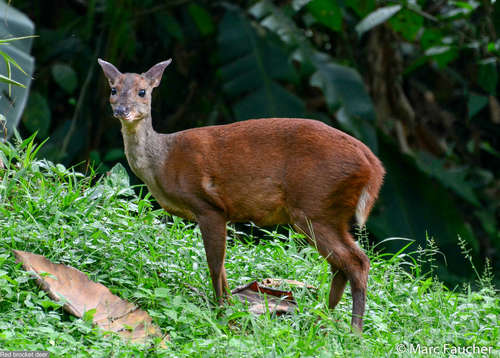
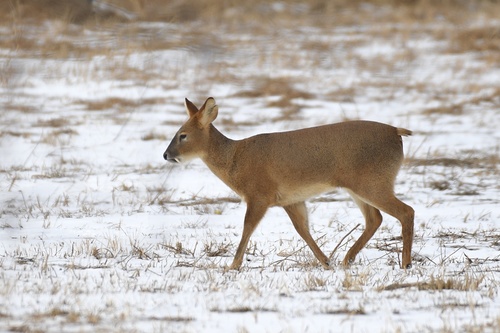
The water deer (Hydropotes inermis) is a small deer species native to China and Korea. It has prominent tusks that resemble those of musk deer.
Formal Scientific Description
Robert Swinhoe first formally described this species for the Western scientific community in 1870.
Prehistoric Distribution
Archeological studies show that water deer had a much broader distribution during the Pleistocene and Holocene periods than they do today. Fossil and subfossil records of historical water deer range from eastern Tibet in the west, Inner Mongolia and northeastern China in the north, to the southeastern Korean Peninsula (Holocene) and the Japanese archipelago (Pleistocene) in the east, and southern China and northern Vietnam in the south.
Historic Range Changes
Water deer also historically lived on Taiwan, and this population is thought to have gone extinct as recently as the early 19th century. Currently, water deer are indigenous to the lower reaches of the Yangtze River, coastal Jiangsu province (including the Yancheng Coastal Wetlands), and the islands of Zhejiang in east-central China, as well as Korea, where the Korean Demilitarized Zone provides protected habitat that supports a large population.
Subspecies Classification
There are two recognized subspecies of water deer: the Korean water deer (H. i. argyropus) is one of the two. The native Chinese subspecies is classified as critically endangered within China, while the Korean subspecies has an estimated population of 700,000 across South Korea.
Current Chinese Population
In China, existing wild water deer populations are found in Zhoushan Islands (Zhejiang, 600–800 individuals), Jiangsu (500–1,000 individuals), Hubei, Henan, Anhui (500 individuals), Guangdong, Fujian, Poyang Lake (Jiangxi, 1,000 individuals), Shanghai, and Guangxi. The species is now extinct in southern and western China.
Chinese Reintroduction Program
Water deer have been reintroduced to Shanghai starting in 2006: the reintroduced population grew from 21 individuals in 2007 to 227–299 individuals in 2013.
Korean Population Details
In Korea, water deer are found across the entire country, where they are known locally as gorani (고라니).
Habitat Preferences
Water deer live on land alongside rivers, where tall reeds and rushes hide them from sight. They can also be found in mountains, swamps, grasslands, and even open cultivated fields.
Swimming Capability
They are skilled swimmers, and can swim several miles to reach remote river islands.
Introduced Global Populations
An introduced population of the Chinese water deer is established in the United Kingdom, while a separate introduced population in France has been completely extirpated.
Breeding Rut Timing
The annual breeding rut for water deer occurs in November and December.
Courtship Behavior
During this time, males seek out and follow females, making soft squeaking contact calls, and check for signs of estrus by lowering their neck, rotating their head, and holding their ears flapped out. Scent is an important part of courtship, and both individuals sniff each other during this process.
Mating System
Water deer mating is polygynous: most females mate within a dominant buck's established territory. After repeated mountings, the final copulation is brief.
Litter Characteristics
Female water deer can give birth to up to seven young per litter, but a litter size of two or three is normal. This makes water deer the most prolific breeder among all deer species.
Fawn Rearing Behavior
Does often give birth to their spotted fawns in open areas, but they quickly move the newborns into dense concealing vegetation, where the young remain hidden most of the time for up to a month. During these first few weeks of life, fawns will occasionally leave cover to play.
Juvenile Dispersal
After being driven out of their natal territory in late summer, young water deer sometimes stay grouped with each other before eventually separating to begin solitary adult lives.
Juvenile Development
Young water deer grow faster and are more precocial at birth than young individuals of other similar deer species.