About Alces alces (Linnaeus, 1758)
Species Nomenclature
This species is Alces alces (Linnaeus, 1758), commonly known as moose.
Shoulder Height
On average, adult moose stand 1.4–2.1 m (4.6–6.9 ft) high at the shoulder. This shoulder height is on average more than 30 cm (1 ft) taller than that of the wapiti, the next largest deer species.
Tail Characteristics
The moose's tail is short, measuring 6–8 cm (2.4–3.1 in) in length, and has a vestigial appearance. Unlike the tails of other ungulates, a moose's tail is too short to swish insects away.
Adult Weight Ranges
Adult male moose (called bulls) normally weigh 380 to 700 kg (838 to 1,543 lb), while adult female moose (called cows) typically weigh 200 to 490 kg (441 to 1,080 lb). Weight varies based on racial or clinal differences, as well as individual age and nutritional status.
Head-and-Body Length
Head-and-body length ranges from 2.4–3.1 m (7 ft 10 in – 10 ft 2 in), and the vestigial tail adds only an extra 5–12 cm (2–4+1⁄2 in) to this total length.
Alaskan Subspecies Size
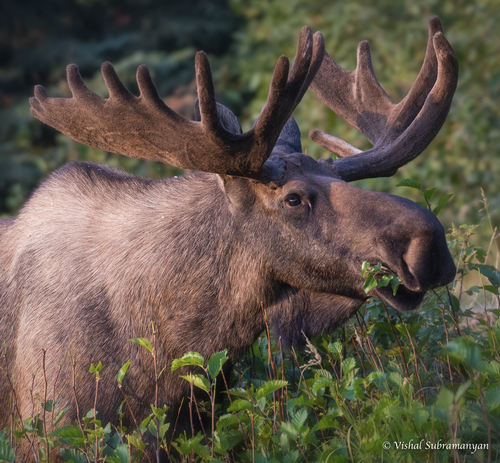
The Alaskan subspecies (A. a. gigas) is the largest of all moose races. Alaskan moose can stand over 2.1 m (6 ft 11 in) at the shoulder, have an antler span of 1.8 m (5 ft 11 in), and average 634.5 kg (1,399 lb) for males and 478 kg (1,054 lb) for females.
Typical Bull Antler Span
For most mature bulls, however, antler span typically falls between 1.2 and 1.5 m (3 ft 11 in and 4 ft 11 in).
Confirmed Maximum Size
The largest confirmed size on record for this species is a bull shot at the Yukon River in September 1897, which weighed 820 kg (1,808 lb) and measured 2.33 m (7 ft 8 in) high at the shoulder.
Unconfirmed Size Reports
There have been reports of even larger moose, including a bull killed in 2004 that weighed 1,043 kg (2,299 lb) and another bull reported to weigh 1,180 kg (2,601 lb), but none of these larger size reports are authenticated, and some are not considered reliable.
General Habitat Requirements
Moose require habitats that provide adequate edible plants (such as pond grasses, young trees and shrubs), cover from predators, and protection from extremely hot or cold weather. Moose move between different habitats with the changing seasons to meet these requirements.
Cold Adaptation Traits
Moose are cold-adapted mammals with thickened skin, a dense heat-retaining coat, and a low surface-to-volume ratio. These traits give them excellent cold tolerance but poor heat tolerance.
Hot Weather Behavior
Moose survive hot weather by accessing shade or cool wind, or by submerging themselves in cool water. In hot weather, moose are often found wading or swimming in lakes or ponds.
Heat Stress Impacts
When heat-stressed, moose may not forage adequately in summer, and may not gain enough body fat to survive the winter. Additionally, female moose may not calve if they do not gain enough weight over the summer.
Forest Habitat Needs
Moose require access to both young forest for browsing and mature forest for shelter and cover. Forest disturbed by fire and logging promotes the growth of fodder that moose eat.
Additional Habitat Requirements
Moose also need access to mineral licks, safe calving sites, and aquatic feeding sites.
Snow Depth Habitat Preferences
Moose avoid areas with little or no snow, because this increases their risk of predation by wolves. They also avoid areas with deep snow, because deep snow impairs their mobility. Because of this, moose select their habitat based on trade-offs between predation risk, food availability, and snow depth.
Bison Competition Concern
After bison were reintroduced to boreal forests, there was concern that bison would compete with moose for winter habitat, and worsen moose population decline. However, this competition does not appear to be a problem.
Early Winter Habitat Partitioning
In early winter, moose prefer sub-alpine shrublands, while bison prefer wet sedge valley meadowlands.
Late Winter Habitat Partitioning
In late winter, moose prefer river valleys with deciduous forest cover or alpine terrain above the tree line, while bison prefer wet sedge meadowlands or sunny southern grassy slopes.
Activity and Social Structure
Moose are mostly diurnal. They are generally solitary, with the strongest social bond being between a mother moose and her calf. Although moose rarely gather in groups, multiple moose may stay in close proximity during the mating season.
Mating Season Timing
Rutting and mating take place in September and October.
Bull Rut Fasting Behavior
During the rut, mature bulls stop feeding completely for a period of approximately two weeks. This fasting behavior has been linked to neurophysiological changes that support redeployment of the sense of smell to detect moose urine and female moose.
Mating System
Male moose are polygynous, and will seek out multiple females to breed with.
Rut Vocalizations
During the rut, both sexes call to one another. Males produce heavy grunting sounds that can be heard from up to 500 metres (1,600 ft) away, while females produce wail-like sounds.
Male-Male Competition
Males fight for access to females. Initially, the males assess which of them is dominant, and one bull may retreat. If dominance is not resolved, the interaction can escalate into a fight using the bulls' antlers.
Gestation and Calving
Female moose have an eight-month gestation period. They usually give birth to one calf in May or June, or twins if food is plentiful.
Twinning Rate
With good nutrition, the rate of twinning can reach as high as 30% to 40%.
Calf Appearance
Newborn moose have fur with a reddish hue, in contrast to the brown fur of adult moose.
Calf Dependency
Calves stay with their mother until just before the next calf is born.
Lifespan and Population Ratio
The average lifespan of a moose is 15–25 years. At one year of age, moose populations are typically stable at a ratio of 25 calves for every 100 cows.
Population Expansion Potential
When adequate nutrition, mild weather, and low predation are available, moose have great potential for population expansion.
Hunting Status
Moose are hunted as a game species in many of the countries where they are found.
Moose Meat Taste Description
In The Maine Woods, Henry David Thoreau wrote that moose meat tastes "like tender beef, with perhaps more flavour; sometimes like veal".
Moose Meat Nutritional Profile
The protein content of moose flesh is similar to that of other comparable red meats (such as beef, deer and wapiti), but moose meat has a low fat content. The fat that is present in moose meat has a higher proportion of polyunsaturated fats than saturated fats.
Swedish Moose Cultural Significance
In his 1999 book Moose: Behaviour, Ecology, Conservation, Valerius Geist wrote that in Sweden, no fall menu is complete without a mouthwatering moose dish.
Swedish Moose Management
The Swedes fence their highways to reduce moose-vehicle fatalities and design moose-proof cars. Sweden is less than half as large as the Canadian province of British Columbia, but the annual moose harvest in Sweden is upward of 150,000, twice the size of the total moose harvest in North America.
Alaska Wolf Cull Rationale
Boosting moose populations in Alaska for hunting is one reason given to allow aerial methods to cull wolves in designated areas. As Craig Medred put it: "A kill of 124 wolves would thus translate to [the survival of] 1488 moose or 2976 caribou or some combination thereof".
Artificial Population Boost Criticism
Some scientists believe that this artificial inflation of game populations is actually harmful to caribou and moose populations, as well as the broader ecosystem. This is because studies show that when game populations are artificially boosted, it leads to habitat destruction and an eventual population crash.