About Hydrophis platurus (Linnaeus, 1766)
Common Name and Distinctive Pattern
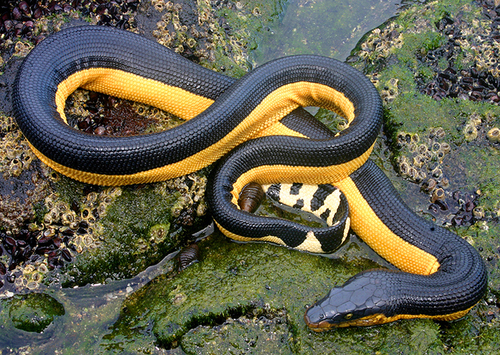
Hydrophis platurus, commonly the yellow-bellied sea snake, has a distinctive bicolor pattern with a yellow underbelly and brown back, which makes it easy to tell apart from other sea snake species.
Marine Adaptation and Reproduction
Like many other sea snake species, yellow-bellied sea snakes are fully adapted to spend their entire lives at sea, mating, feeding, and giving birth to live young in an ovoviviparous reproductive process.
Aquatic Adaptations
Adaptations for aquatic life include reduced ventral scale size, a laterally compressed body, and a paddle-shaped tail for swimming; valved nostrils and a palatine seal to keep seawater out; and cutaneous gas exchange to extend how long the snake can dive.
Cutaneous Gas Exchange
This species can meet up to 33% of its oxygen requirements through its skin while diving and swimming at the water surface.
Salt Gland Function
Sea snakes have a special salt gland located in the lower jaw; this gland was formerly thought to filter salt from surrounding seawater, but research has found it is not used for this purpose, as sea snakes only drink fresh water.
Scale Terminology Note
For terminology related to snake scales, see snake scales.
Body Shape Morphology
Morphologically, this snake has a compressed body, with the posterior section less than half the diameter of the neck.
Body Scale Characteristics
Its body scales are juxtaposed and subquadrangular in shape, arranged in 23–47 rows around the thickest part of the body.
Ventral Scale Features
Ventral scales number 264–406, are very small, and if distinct, divided by a latitudinal groove; they are usually indistinguishable from adjacent body scales.
Head and Snout Shape
The head is narrow, with an elongated snout.
Head Shield and Nostril Features
Head shields are entire, nostrils are positioned superiorly, and nasal shields contact one another.
Prefrontal Scale Feature
The prefrontal scale contacts the second upper labial.
Ocular and Temporal Scale Counts
There are one or two preoculars, two or three postoculars, two or three small anterior temporals, and seven or eight upper labials.
Subocular Scale Feature
Four or five upper labials sit below the eye, but are separated from the eye border by a subocular.
Common Color Pattern
Coloration is variable, but most often the snake is distinctly bicolored: black above, yellow or brown below, with a sharp line dividing dorsal and ventral colors.
Ventral Pattern Variations
On the yellow or brown ventral background, there may be a series of black spots or bars.
Dorsal Pattern Variations
Alternatively, the yellow color may extend onto the dorsal side, leaving only a narrow middorsal black stripe, or a series of black crossbars.
Maximum Total Length
Maximum total length is 720 mm (28 in) for males and 880 mm (35 in) for females.
Maximum Tail Length
Maximum tail length is 80 mm (3.1 in) for males and 90 mm (3.5 in) for females.
Global Distribution Status
The yellow-bellied sea snake is one of the most widely distributed snakes in the world.
Pelagic Movement Behavior
It is completely pelagic, and is often observed on oceanic drift lines, using surface currents and storms to move across the ocean.
Distribution Determinants
Its distribution is largely determined by favorable water temperatures, oceanic currents, and recently formed land bridges that block further dispersal.
Indo-Pacific Range
It has an extensive distribution covering the entire tropical Indo-Pacific, and extends to Costa Rica, southern California, and northern Peru.
Hawaiian Islands Presence
It is the only sea snake that has reached the Hawaiian Islands.
Preferred Hunting and Reproduction Habitat
Its preferred habitat for hunting and reproduction includes free-floating mats of sea kelp found in the Indian Ocean.
Southwest Australia Beaching Records
It is the most commonly beached sea snake on the coast of Southwest Australia, including records at beaches near metropolitan areas.
Australian Outlying Island Records
It has also been reported from Australia's Christmas Island and Cocos (Keeling) Islands.
Minimum Water Temperature Requirement
Long-term survival for this species requires a minimum water temperature of 16–18 °C (61–64 °F).
Cold Water Occurrences
Even so, the species has been reported in colder Pacific waters, including the coasts of southern California, Mexico, Tasmania, and New Zealand.
New Zealand Stranding Context
New Zealand would otherwise have no native snakes if not for infrequent strandings of yellow-bellied sea snakes and banded sea kraits.
New Zealand Occurrence Status
Despite being made up of wayward individuals, these occurrences make the yellow-bellied sea snake the most commonly seen snake (and most commonly seen sea snake) in New Zealand.
New Zealand Protection Status
As a result, the species is considered native (indigenous) to New Zealand and is protected under the Wildlife Act 1953.
Cold Water Dispersal Cause
These occurrences in colder water are believed to be linked to El Niño and other severe weather events, which may create unusually strong new ocean currents that transport the snakes far off their normal course.
2015 California Stranding
In October 2015, a beached yellow-bellied sea snake was reported and photographed in Ventura County, California, well outside the species' normal range, for the first time in 30 years.
2016 California Stranding
A few months later, in January 2016, a stranded individual was found washed up on the north end of Coronado Beach (better known as Dog Beach) in Coronado, California, just south of Naval Air Station North Island (NASNI).
2016 California Specimen Disposition
The specimen was later transported to the Scripps Institute of Oceanography in La Jolla for examination.
Atlantic Ocean Occurrence
The yellow-bellied sea snake is the only sea snake that has been found in the Atlantic Ocean, though this only occurs in limited circumstances.
Atlantic Range Status
Its presence in the Atlantic is not considered part of its native range, but rather the result of dispersal from its native Pacific range.
Eastern Africa and Island Records
It has been found in all countries along Africa's eastern coast and all eastern African islands, including Djibouti, Eritrea, Kenya, Madagascar, Mauritius, Mayotte, Mozambique, Réunion, Seychelles, Somalia, South Africa, and Tanzania.
Western Africa Atlantic Records
On Africa's Atlantic coast, it has been reported in the Benguela Current, with specimens found along the coasts of South Africa and Namibia.
Caribbean Sea Occurrence
It has also been found four separate times in the Colombian Caribbean, making it the only sea snake recorded in the Caribbean Sea.
Caribbean Non-Native Status
However, these occurrences are believed to result from human activity, such as ship discharge, intentional release, or passage through the Panama Canal, and the species is not considered native to the Caribbean.
Isthmus of Panama Dispersal Barrier
The Isthmus of Panama, the land bridge between North and South America that formed between roughly 10 million and 3 million years ago, acts as a dispersal barrier that prevents the species from entering the Caribbean from the Pacific.
Panama Canal Crossing Barrier
The man-made Panama Canal is presumed to not allow crossing because it is filled with fresh water.
Assumed Population Gene Flow
Due to the species' wide distribution and relative lack of dispersal barriers, it has long been assumed that individuals from different localities belong to a single breeding population, meaning there is high gene flow between groups.
Costa Rican Population Genetic Structure
However, a study using haplotype networks on two populations from Costa Rica found shallow genetic population structure that aligns with variation in color patterns: brown and yellow in Golfo de Papagayo, and completely yellow in Golfo Dulce.