About Hydrocotyle sibthorpioides Lam.
Leaf Width
Description: Leaf width of Hydrocotyle sibthorpioides ranges from 0.5 to 2 cm.
Growth and Flower Traits
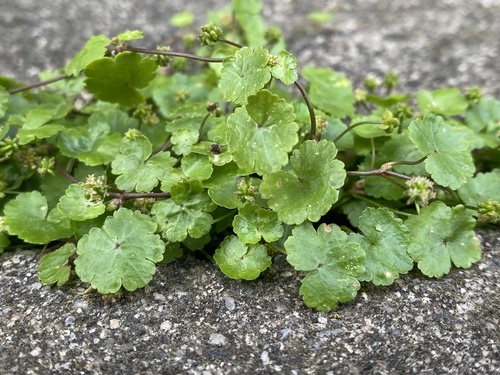
This species has a moderate growth rate, and produces small flowers that are faint yellow with a hint of purple. Its flower clusters are simple, with a flat-topped or rounded shape.
Flower Structure
Each flower has inconspicuous involucral bracts at its base, and indistinct sepals.
Leaf Structure
The leaves are simple, broad, and alternate, with a small leafy outgrowth at the base. They are kidney-shaped to round, with scalloped edges; peltate leaves of this species are often described as egg-shaped. All leaves are hairless, and typically have five to seven shallow lobes around the edge.
Fruit Characteristics
Mature fruits are flat and split in half at maturity, with one seed on each half after splitting. Fruits are elliptical to round with thin ridges, and have no oil tubes (vitta) — a trait characteristic of the fruit of umbelliferous plants.
Geographic Distribution
Distribution and habitat: Hydrocotyle sibthorpioides is most common in southeastern Asia. It is native to Asia, but grows successfully as an introduced species in parts of the United States, especially the eastern US and some areas of California. It has recently been reported to grow well in southeast Australia, where it occurs in Brisbane and Sydney; it is native to Western Australia.
Habitat Types
This species can grow in a wide range of habitats, from dry areas to sites that are occasionally submerged. It can also be found growing between sidewalk cracks, and is increasingly common as a lawn weed.
Toxicity Research
Toxicity: The phytoconstituents of H. sibthorpioides have been found to have a wide range of potential therapeutic uses, though pharmacological use is only justified with a satisfactory safety profile. There is no record that the plant or its extracts have ever been tested in a clinical experiment. Following OECD standard 425, Hazarika et al. (2019) carried out a preclinical acute toxicity study on multiple extracts of H. sibthorpioides using albino rats, and found that the LD50 was greater than 2000 mg/kg of body weight.
Global Traditional Uses
Use in traditional medicine: Many tribes worldwide use H. sibthorpioides to treat fever, edema, dysentery, rheumatalgia, whooping cough, jaundice, throat discomfort, psoriasis, herpes zoster infection, and hepatitis-B infection, as well as to relieve pain, and treat dysmenorrhoea and carbunculosis.
South Asian Traditional Uses
In Assam, it is also used as a hepatoprotective agent, a brain tonic, and a detoxifying agent. Bengali villagers use the whole plant to treat bone fractures.
Extract Toxicity Data
Extracts of this plant tested on rats showed no toxicity at doses up to 2000 mg/kg.
Chinese Medicine Name
In Chinese traditional medicine, this species is called Jiangxi Jinqiancao.