About Hedera hibernica Poit.
Growth Habit
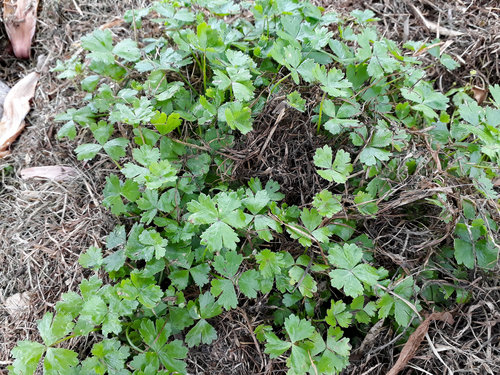
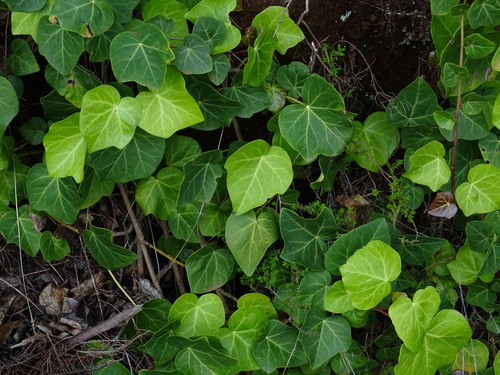
Hedera hibernica Poit. is an evergreen climbing plant. Where suitable vertical surfaces such as trees, cliffs, and walls are available, it grows to 20–30 metres high; when no vertical surfaces are present, it grows as ground cover. It climbs using aerial rootlets that cling to the substrate.
Species Distinction
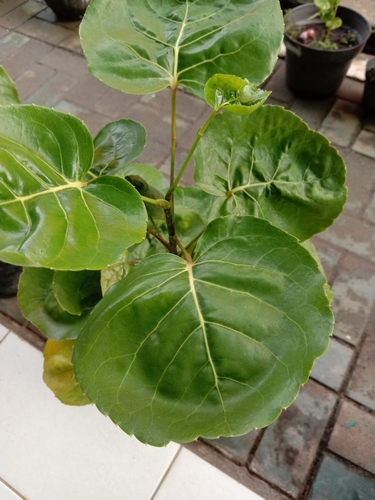
One key difference between this species and Hedera helix (common ivy) is that the light veins on its leaves are less pronounced.
Bark Characteristics
Its young bark is green, and quickly turns gray; old branches have light gray, finely furrowed bark.
Bud Morphology
Buds are mostly hidden by the leaf base, are egg-shaped, and bright green.
Non-Flowering Leaf Morphology
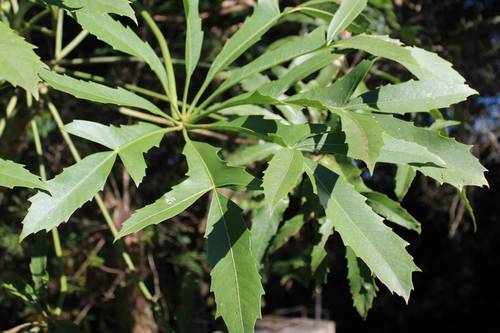
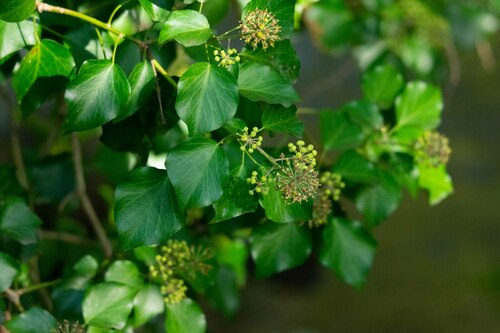
Most leaves have entire margins, and are either ovoid or have five triangular lobes; the upper leaf surface is glossy dark green with light ribs, while the underside is pale green. Leaves on flowering shoots are oval with entire margins.
Flowering and Fruiting
It flowers from September to October, and produces blue-black berry fruits.
Toxicity
The whole plant, including the berries, is slightly poisonous.
Soil and Light Requirements
Ecologically, Hedera hibernica needs consistently moist soil, and can grow in any light condition from full sun to deep shade.
Native Habitat
Its native natural habitat is cool, cloud-covered forest or dense bush found for most of the year, which is common in mountainous regions near the ocean.
Preferred Soil Properties
It grows best in well-drained or alkaline soils that are rich in nutrients and humus.
Invasive Potential
In regions where it has been introduced, it can become a noxious, invasive weed.
Ecological Role for Insects
In autumn, its flowers are a major source of nectar for many insects, including the ivy bee Colletes hederae.
Ecological Role for Birds
Its berries provide winter food for common wood pigeons, thrushes, common blackbirds, and the Eurasian blackcap, and some small bird species use the cover it forms as nesting sites.
Distribution Range
Native to the Atlantic region, Hedera hibernica has been cultivated, and now grows wild outside its original range along the Atlantic coast from Portugal, Spain, and France, to Ireland, Great Britain, Germany, Scandinavia, and the Baltic Sea.
Cultivation Status
The plant has an attractive, elegant appearance, and is very common in gardening; it has been awarded the Royal Horticultural Society's Award of Garden Merit.
North American Invasion
Like the closely related H. helix (English ivy), H. hibernica is an invasive weed in parts of North America that have mild winters. A recent study found that 83% of 119 sampled invasive ivy populations in the Pacific Northwest were H. hibernica, rather than H. helix as previously believed.
Garden Management Note
It can even become problematic in gardens, rapidly colonizing hedges, trees, and garden borders if not kept contained.