About Hydrastis canadensis L.
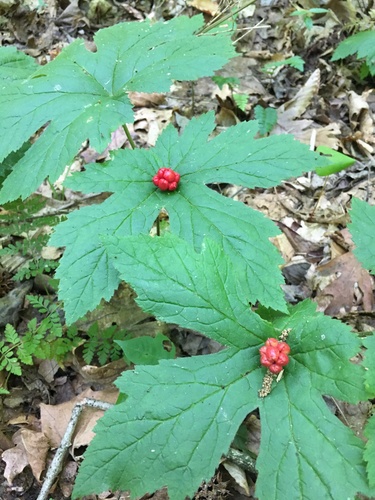
Hydrastis canadensis L., commonly known as goldenseal, is a herbaceous perennial plant that grows from a thick, horizontal yellowish rhizome covered in knobby knots. Its finely hairy, upright unbranched stems reach between 15 and 50 centimeters (6 to 19.5 inches) in height. Fertile individuals produce a single stem that bears two palmately lobed leaves. Flowering plants grow one single terminal flower that has no petals, three sepals, and 12 or more noticeable white pistils; it blooms for a short period in spring. Fertilized flowers develop into red, raspberry-like fruits that contain one or two seeds each.
This species is native to southeastern Canada and the eastern United States, where it grows in mesic forests beneath deciduous trees. It occurs most often in sheltered ravines or on talus slopes. Goldenseal is intolerant of disturbances to the tree canopy and of grazing, and it often grows alongside other uncommon plants including Jeffersonia diphylla (twinleaf) and Dicentra canadensis (squirrel corn).
According to the American Cancer Society, goldenseal can cause toxic side effects, and high doses can result in death. Possible side effects include digestive complaints, nervousness, depression, constipation, rapid heartbeat, diarrhea, stomach cramps and pain, mouth ulcers, nausea, seizures, vomiting, and central nervous system depression. Very high doses may lead to breathing problems, paralysis, and death. Long-term use can cause vitamin B deficiency, hallucinations, and delirium. Goldenseal can cause brain damage in newborn babies if given directly to the infant, or if consumed by pregnant or breastfeeding mothers. It can also affect blood pressure in unpredictable ways, because it contains multiple compounds that have opposing effects on blood pressure readings. Long-term use of goldenseal reduces the body's ability to absorb B vitamins, and medical guidance warns people to avoid goldenseal during pregnancy and lactation, when experiencing gastrointestinal inflammation, and when managing pro-inflammatory disorders. A 2011 study found that rats fed goldenseal consistently for two years had an increased tendency to develop tumors. Goldenseal has been measured to inhibit the activity of the cytochrome P450 enzymes CYP2D6, CYP3A4, and CYP3A5 by approximately 40%, a reduction that is both statistically and clinically significant. CYP2D6 is an enzyme that metabolizes many commonly used prescription medications, including most antidepressants (all SSRIs except fluvoxamine), neuroleptics, codeine, and metformin. Combining goldenseal with these medications should only be done cautiously under a doctor's supervision, as it can lead to serious, potentially fatal toxicity. People with a genetic deficiency in these enzymes face particularly high risk.
As of 1998, only 2.4% of commercially used goldenseal plant material came from cultivated sources, rather than wild harvesting. This proportion was projected to increase by 15–30% over the subsequent several years. In response to conservation concerns about wild populations, research into propagation of wild-sourced material for commercial production has expanded. Goldenseal grows in patches of interconnected ramets, and reproduces asexually via clonal propagation, so transplanting rhizome propagules into cultivated settings is possible. Seed propagation is also feasible, and offers benefits like lower cost and greater genetic variability, but it is considered difficult and unpredictable. Commercial goldenseal can be cultivated via agroforestry in natural settings that match the species' native ecological conditions, or on farms with artificial shade canopies.
Another propagation approach uses controlled environments like greenhouse growing labs, where the plant's required environmental conditions—including light, water, and temperature—are artificially controlled. Crop selection and biotechnology experimentation can be used to increase harvest yield and pharmacological potency. Controlled environments greatly reduce the amount of time needed to grow goldenseal to a harvestable size. While forest-cultivated goldenseal doubles in mass every three to five years, plants grown in growth chambers can double in mass every 15 weeks, and triple in mass when grown in coarse soil medium. Subculturing can be completed every 30 days to mass-propagate the plant. Cultivation in new non-native regions is also possible: a six-year experiment conducted by Douglas et al. grew goldenseal in the warm temperate climate of New Zealand. Yields in the sixth year of growth were 74% higher than yields in the fourth year, which is the typical harvest age for goldenseal. The overall growth of this non-native goldenseal was comparable to growth of goldenseal in its native United States, and concentrations of hydrastine and berberine fell within the standards set by the United States and Europe. Cultivation of goldenseal in New Zealand environments that are similar to its native range is a viable option to support sustainable population of the species.
At the time of European colonization of the Americas, goldenseal was widely used by several Native American tribes of North America, both as a medicine and as a coloring material. In 1798, Benjamin Smith Barton documented Cherokee use of goldenseal as a cancer treatment; he also noted its properties as a bitter tonic, and as a local wash for ophthalmia. It became a popular herb among the Eclectic medical movement starting in the 1830s, when Constantine Raffinesque promoted it. Native tribes also used goldenseal to treat digestive issues, as an eyewash, as a diuretic, and as a bitter tonic. According to the American Cancer Society, available scientific evidence does not support claims that goldenseal is effective in treating cancer or any other disease. The National Center for Complementary and Integrative Health similarly states that scientific evidence does not support the use of goldenseal for any health-related purpose. In the early 20th century, goldenseal was used as a yellow dye, an astringent, and an insect repellent.