About Hibiscus acetosella Welw. ex Ficalho
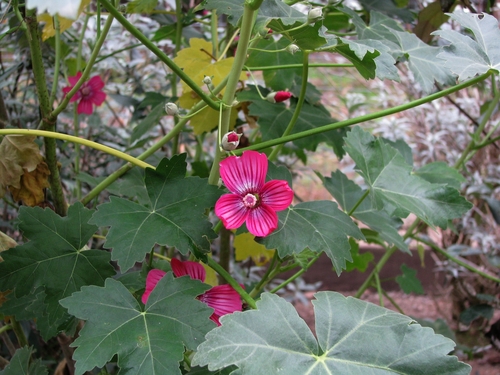
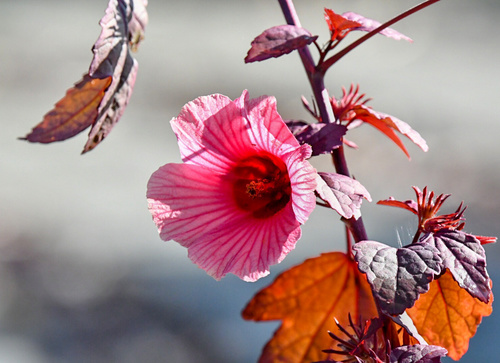
Hibiscus acetosella, commonly called cranberry hibiscus, has foliage that is similar in shape to Japanese maple foliage. This species is a dicot, with leaves that change shape along the stem: lower leaves have 3 to 5 lobes, while upper leaves are unlobed or undivided. Mature leaves are roughly the size of a small child's hand, measuring approximately 10 by 10 cm. Leaves are arranged alternately along the stem, are simple in structure, deeply cut, and have crenate or jagged edges. Leaf color ranges from dark maroon to a patchy mix of red and green. Its linear stipules grow to around 1.5 cm long. Both the stems and 3–11 cm long petioles are smooth and mostly hairless. Hibiscus acetosella is placed in the section Furcaria, a group of around 100 Hibiscus species defined by non-fleshy calyxes and sepals. The sepals have 10 veins total: 5 veins run to the tips of the sepal segments, and the other 5 run to the gaps between segments. Stems are typically variegated. Flowers grow singly, each borne on a 1 cm long pedicel. Most flowers are the same dark maroon color as the plant's foliage, with darker vein-like markings; yellow flowers are very rare. Flowers are around 5 cm (2 inches) deep. Each flower holds many stamens that reach about 2 cm in length. Cranberry hibiscus is hermaphroditic and thought to be self-pollinating. It produces dark brown, kidney-shaped (reniform) seeds that measure 3 by 2.5 mm.
Cranberry hibiscus is primarily known for its young leaves, which have a slightly sour to pleasant tart flavor. These leaves are commonly eaten as a vegetable, either raw or cooked. In South America, they are added in small quantities to salads and stir-fries. People typically eat the leaves in small portions because of their acid content and mucilaginous texture. When cooked, cranberry hibiscus leaves keep their dark color, so they are also used as a decorative garnish for dishes. The flowers are used to make teas and other drinks, adding a deep rich color rather than strong flavor, and are sometimes attributed mild medicinal benefits. In Central America, flowers are mixed with ice, sugar, lemon or lime juice, and water to make purple lemonade. The root is edible, but it is considered fibrous and unpleasant-tasting. Unlike the related species Hibiscus sabdariffa (commonly used to make the beverage jamaica), the calyx (sepals) of H. acetosella is non-fleshy and is not eaten. In Angola, tea brewed from cranberry hibiscus leaves is used as a post-fever tonic and to treat anemia. Crushed leaf-infused cold water is used to treat myalgias, and this preparation is also used for bathing children. The plant is thought to contain polyphenols, compounds that may fight inflammation, which are often used to treat inflammatory conditions.