About Heniochus pleurotaenia Ahl, 1923
Size
The phantom bannerfish (Heniochus pleurotaenia Ahl, 1923) is a small fish that reaches a maximum length of 17 cm.
Body Shape
Its body is laterally compressed, and the first rays of its dorsal fin extend into short, white, feather-like filaments.
Base Coloration
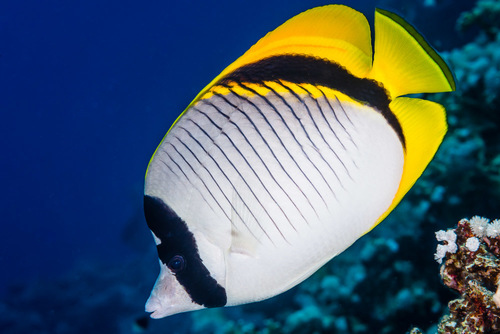
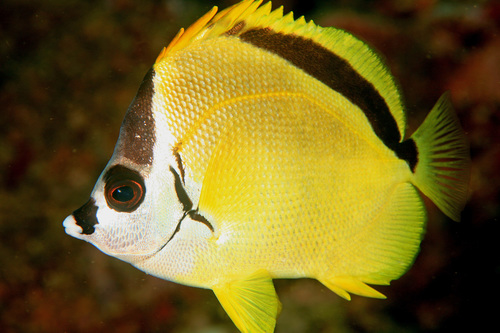
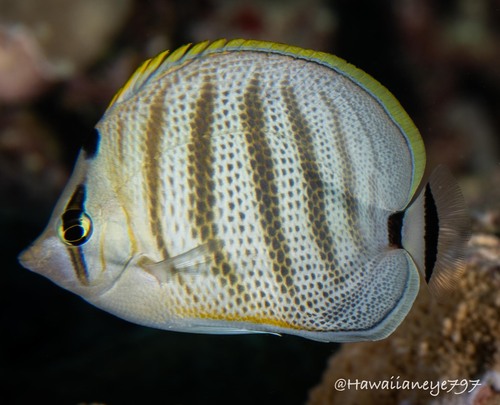
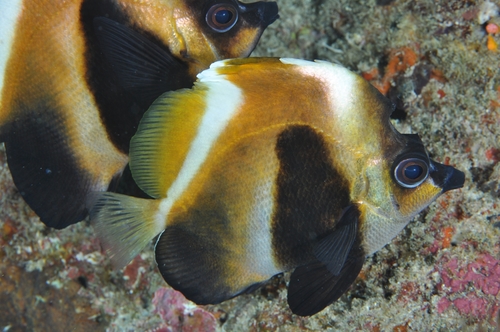
Its base body color is white, with light chocolate to dark colored markings, including a brown face mask that covers the mouth and eyes, and extends to the base of the first dorsal fin rays.
Snout and Mouth
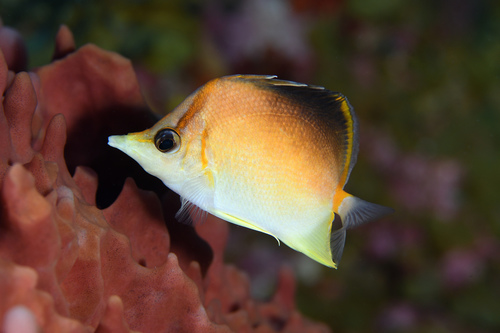
It has an elongated snout with a small, terminal, protractile mouth.
Facial Features
A small horn sits between the eyes, and a rounded frontal growth creates a concave profile to the fish's face.
Body Marking 1
A second dark marking forms an inverted "v" shape that starts at the ventral fins and ends at the anal fin.
Body Marking 2
A third chocolate-colored marking runs from the last dorsal fin rays to the base of the caudal peduncle.
Similar Species Distinction
This species can be confused with the very similar horned bannerfish, Heniochus varius, which lacks the inverted v pattern on the sides.
Juvenile Identification
Juveniles, which do not have the white insert, can be told apart by the shorter extension of the first dorsal fin rays.
Distribution Range
The phantom bannerfish is widespread across tropical and subtropical waters of the central Indo-Pacific, ranging from the Maldives to the western coast of Thailand, and from the southern tip of India to Java, Indonesia.
General Habitat and Depth
It lives in coral-rich areas in shallow lagoons and external reef slopes, from the surface down to 25 meters depth.
Social Grouping
It occurs in pairs or aggregations: in Indonesia, it is typically found in pairs in coastal waters, while it may gather into schools in offshore areas, and can form very large schools in some locations such as the Maldives.
Reef Crest Occurrence
It can be found at a range of depths, and is frequent on shallow reef crests exposed to surge.
Habitat Preference
It appears to prefer mixed algae and coral habitats down to 15 meters, but also occurs in deeper offshore waters.
Reproduction
It is an oviparous species that forms breeding pairs.