About Hemiphora bartlingii (Lehm.) B.J.Conn & Henwood
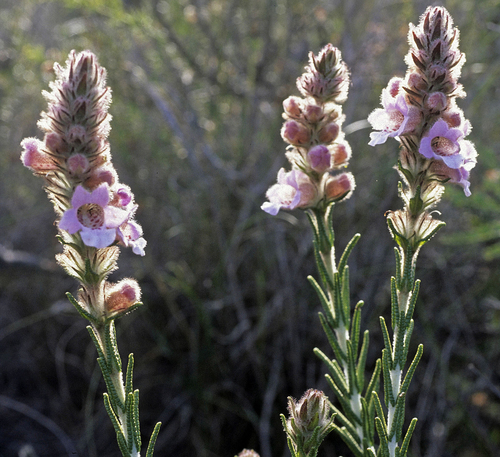
Hemiphora bartlingii, commonly known as woolly dragon, is a shrub that reaches a height of 0.3 to 0.9 metres (1 to 3 feet). Its branches are densely covered in greyish, rusty-coloured hairs. The leaves are linear to lance-shaped, but often look almost cylindrical because their edges are strongly rolled under. Leaves measure 3 to 4 cm (1 to 2 in) long and 3 to 5 mm (0.1 to 0.2 in) wide, with a blistered upper surface and a hairy lower surface. Flowers are arranged singly or in groups of up to three in leaf axils near the ends of branches, growing on woolly stalks 2 to 4 mm (0.08 to 0.2 in) long. Flowers are surrounded by leafy, linear to lance-shaped, woolly bracts and bracteoles; these structures are densely woolly on the outer surface, and less hairy on the inner surface. The bracts are 15 to 25 mm (0.6 to 1 in) long, and are longer than the sepals. The five sepals are 8 to 13 mm (0.3 to 0.5 in) long, linear to lance-shaped, woolly on their outer surface, and joined at the base to form a short tube. Petals are 15 to 23 mm (0.6 to 0.9 in) long, and joined for most of their length to form a broad tube that is white, pink, or purple with purple spots inside. The outer surface of the petal tube has a small number of short hairs, and the inner surface is glabrous except for a narrow ring of hairs around the ovary. There are five lobes at the end of the petal tube: the lower central lobe is elliptic to almost round, 6 to 9 mm (0.2 to 0.4 in) long and 7 to 11 mm (0.3 to 0.4 in) wide, and it is much larger than the other four lobes, which are similar in size and shape to each other. The four stamens are shorter than the petal tube, with the lower pair being slightly longer than the upper pair. Flowering occurs in most months of the year. The fruit is oval-shaped, 3 to 4 mm (0.1 to 0.2 in) long, and has sepals that remain attached to it. This species mostly occurs north of Perth, Western Australia, and is found between Busselton and the Murchison River, sometimes extending as far east as Yellowdine. It grows in sandy kwongan and woodland in the Geraldton Sandplains, Swan Coastal Plain, Avon Wheatbelt, Jarrah Forest and Mallee biogeographic regions.