About Helicteres isora L.
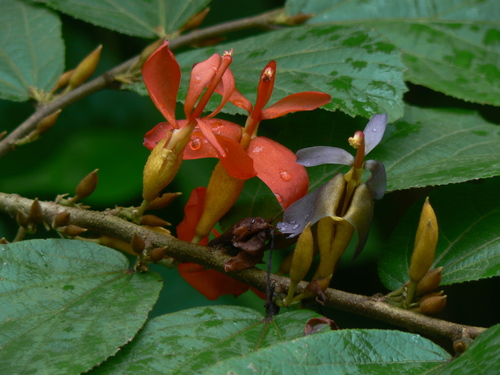
Helicteres isora L. is a small tree or large shrub that reaches 5 to 8 metres in height. It has grey bark, and alternately arranged, hairy, ovate leaves with serrate margins. Its flowers are brick red or orange-red. Unripe fruits of this plant are green, while dried fruits are brown or grey; fruits are twisted, with a screw-shaped structure at the pointed end. The plant's seeds are black or brown, highly polished, roughly rhomboid, and may be rectangular or triangular. Recorded pollinators of its flowers include the jungle babbler, the golden-fronted leafbird, the ashy drongo, and the white-bellied drongo. This is a tropical Asian plant. It can be found across India and Pakistan, Nepal, Myanmar, Thailand, and Sri Lanka. It grows gregariously on hill slopes in the dry deciduous forests of central and western India. It is also found on the Malay Peninsula, Java, and Australia. The fruits and roots of Helicteres isora L. are used in the traditional medicine systems of Asia, Iraq, and South Africa, where they are considered useful for treating a wide range of conditions including gastrointestinal disorders, diabetes, cancer, and infections. There do not appear to be any scientific investigations that confirm these traditional uses. However, laboratory studies have found that both bacteria and cancer cells tend to have reduced survival when exposed to fruit extracts from this plant. Animal studies have shown that root extracts can improve glucose tolerance in diabetic rats.