About Thomasia grandiflora Lindl.
Common Name and Growth Habit
Thomasia grandiflora, common name large-flowered thomasia, is a small shrub that grows to around 1 metre (3 feet 3 inches) tall and wide.
Leaf Shape
Its dark, bright green leaves vary in shape, most commonly heart-shaped, and occasionally narrowly elliptic.
Leaf Texture and Size
The leaves are slightly flexible, leathery, and measure 15 to 25 millimetres (0.59 to 0.98 inches) long.
Calyx Characteristics
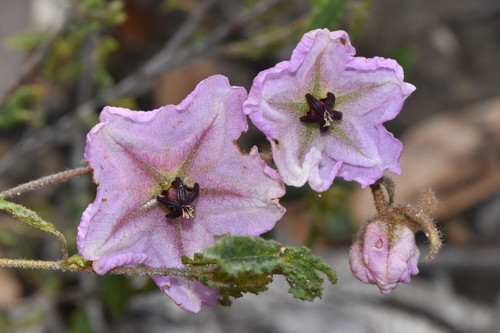
The flowers of this species have wide, noticeable pinkish-purple calyx lobes that are more prominent than the petals. The calyx is thicker near its mid-vein.
Petal Hair Covering
The small petals are densely covered with star-shaped hairs, and occasionally only have a few scattered hairs.
Flower Texture and Stalks
The flowers have a papery texture, measure about 2 centimetres (0.79 inches) across, and grow on short pendant stalks.
Fruit and Seeds
After flowering, the plant produces capsules that contain black seeds, which are shed from the plant when they ripen.
Flowering Period
Flowering of Thomasia grandiflora takes place from winter through to spring.
Species Distribution Range
Large-flowered thomasia is a widespread species.
Habitat
It occurs mostly in near-coastal areas of the south-west of Western Australia, where it grows in open forest.