About Abutilon incanum (Link) Sweet
Nomenclature and Distribution
Abutilon incanum (Link) Sweet, commonly called hoary abutilon, pelotazo, pelotazo chico, tronadora, and known as maʻo in Hawaiʻi, is a shrub that is widely distributed across arid, warm regions of the southwestern United States, northern Mexico, and Hawaiʻi. This species grows to a height of 0.5 to 2 metres (1.6 to 6.6 ft).
Leaf Characteristics
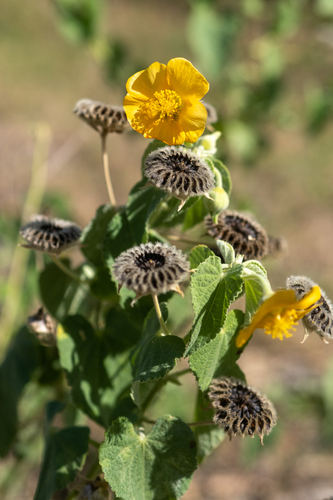
Its leaves are ovate to lance-ovate in shape with crenate margins, measuring 0.5–3 centimetres (0.20–1.18 in) wide and 1.5–6 centimetres (0.59–2.36 in) long.
Flower Features and Subspecies Differences
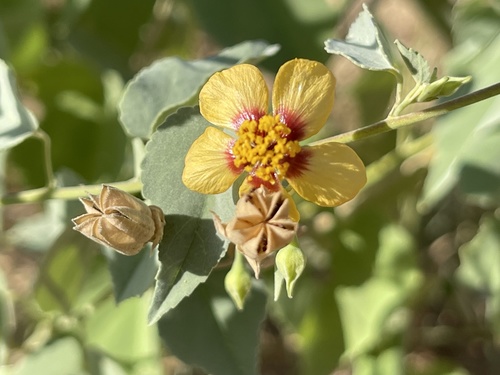
It produces solitary 5-petaled flowers that are generally orange; there are distinguishing traits between its two accepted subspecies: for A. incanum subsp. incanum, flowers are 6–10 millimetres (0.24–0.39 in) long and orange-yellow, while for A. incanum subsp. pringlei, flowers are only 4–6 millimetres (0.16–0.24 in) long and colored deep orange with maroon spots.
Fruit Characteristics
Its fruits are 5–8-millimetre (0.20–0.31 in) capsules that contain 4–6 cells.
Continental Habitat and Elevation
Abutilon incanum prefers rocky slopes and gravelly flats, and also grows in arroyos, at elevations up to 1,370 metres (4,490 ft) in its continental range.
Climatic Requirements and Range Limits
This species requires warm-season rain and mild winters, so it occurs in the Sonoran Desert but is not present in the Mojave Desert.
Hawaiian Habitat and Elevation
In Hawaiʻi, maʻo grows in dry forests and low shrublands at elevations ranging from sea level to 220 metres (720 ft).