About Hedera colchica (K.Koch) K.Koch
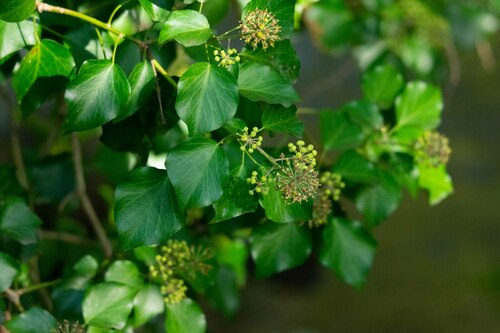
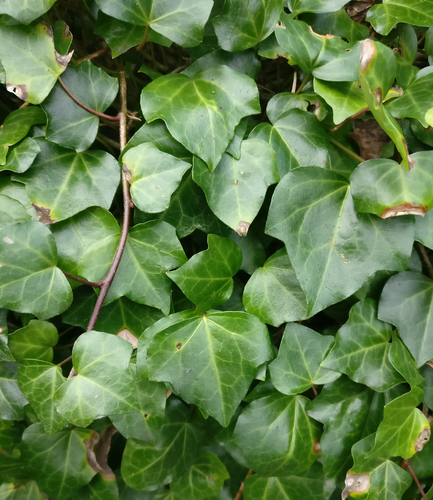
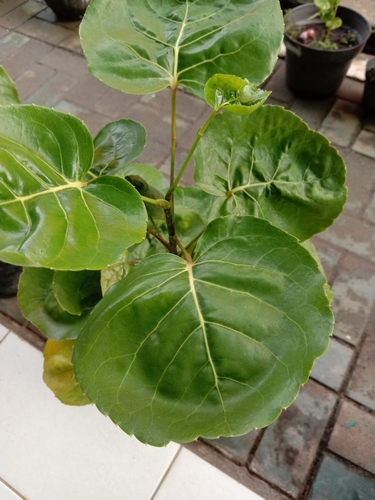
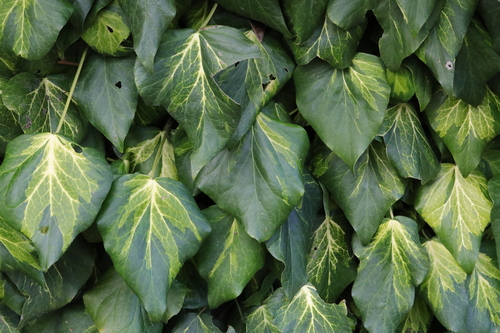
Hedera colchica (K.Koch) K.Koch has alternate leaves that grow in two forms. Creeping and climbing stems bear palmately five-lobed juvenile leaves, while fertile, sun-exposed flowering stems that are usually found high in tree crowns or on the tops of rock faces bear unlobed, cordate, lauroid-type adult leaves. Its stems are green. It has the largest leaves of any ivy, growing up to 15 cm wide and 25 cm long. Flowers are produced from late summer to late autumn; they are individually small and greenish, borne in large numbers in umbels, and very rich in nectar, making them an important food source for bees and other insects. This species flowers in September, and fruits develop during or after winter. Ripe fruits are globular, black berries that form an important food source for many birds. Each berry holds 1 to 5 seeds, which are dispersed when birds swallow the berries. Three cultivars of this species have gained the Royal Horticultural Society's Award of Garden Merit: H. colchica 'Dentata', commonly called Bullock's heart ivy or Elephant's ears; 'Dentata variegata', which has the synonyms 'Dentata aurea' and 'Variegata'; and 'Sulphur heart', which has the synonym 'Paddy's pride'. This is a woody evergreen climbing shrub that can grow in a range of conditions. It prefers well-drained or alkaline soils that are rich in nutrients and humus with good water availability, but it is extremely hardy and highly adaptable. Like many climbing plants, it prefers its roots to be in cool shade while its crown grows in full sun. It can live over 400 years, and can reach heights of 30 m when suitable climbing surfaces such as trees, cliffs, or walls are available. It climbs using aerial rootlets with matted pads that cling strongly to the underlying substrate. It favours humid microclimates, such as cloud forest and stream valleys, and is naturally found in the mountain ranges along the Turkish Black Sea coast, Asia Minor, the Persian Gulf region, Afghanistan, and some Red Sea islands.