About Hakea petiolaris Meisn.
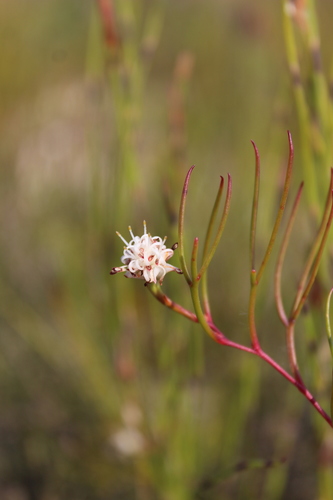
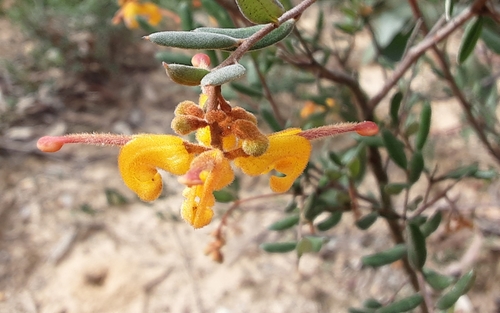
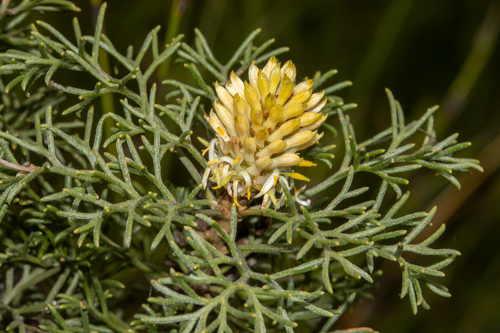
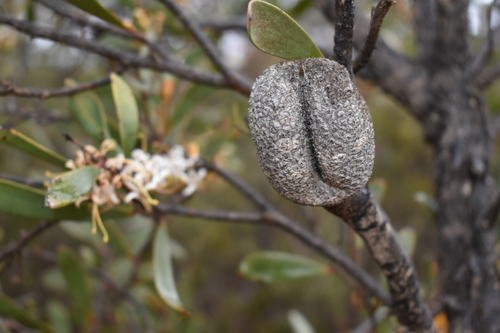
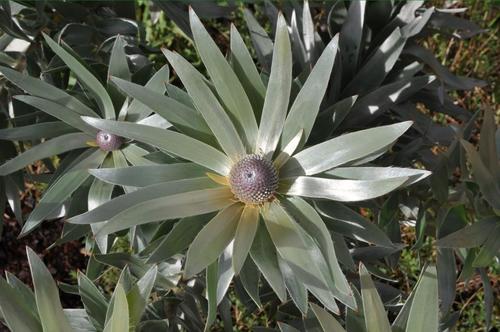
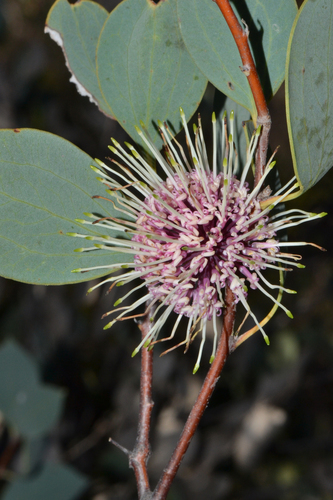
Hakea petiolaris Meisn. typically grows as an erect shrub or tree reaching up to 9 metres (30 feet) in height. Its leaves are a distinctive pale grey, 5.5–15 cm (2–6 in) long and 2.5–6 cm (1–2 in) wide. Flowers form in clusters on small branches or at branch forks; these roughly spherical clusters hold 120 to 200 individual flowers. Each flower measures 1.4–1.8 cm (0.6–0.7 in) long, and is white or cream, with the non-reproductive perianth ranging from pink to purple in colour. After flowering, the plant produces woody seed capsules that are 2–3.5 cm (0.8–1 in) long and 1–2 cm (0.4–0.8 in) wide. Each capsule splits open into valves to release two dark brown or black winged seeds. This species has three recognised subspecies with distinct distributions and habitats. Subspecies petiolaris grows in jarrah forest, most often near granite outcrops, between the Darling Range and York, within the Avon Wheatbelt, Jarrah Forest and Swan Coastal Plain biogeographic regions. Subspecies trichophylla grows near granite outcrops in shrubland near Wongan Hills, with additional isolated populations near Kununoppin and Tuttanning Nature Reserve east of Pingelly, within the Avon Wheatbelt, Jarrah Forest and Mallee biogeographic regions. Subspecies angusta is known only from a small number of small populations growing around granite outcrops near Pingaring in the Mallee biogeographic region. In ecological terms, the growth of flowers directly on the stem, called cauliflory, may be a relictual trait from when this region was dominated by tall forest, and pollinators such as birds moved through the dense leaf canopy of understorey species. For cultivation, Hakea petiolaris is propagated from seed, and grows into a large shrub or tree reaching around 10 metres in height with a width of approximately 2 metres. Horticultural uses include use as a screening plant or hedge, or planting as a single individual specimen. It is fast-growing and hardy, frost resistant, attracts birds, and works well as a feature plant. This species is recommended for its attractive flowers and its ability to draw birds. Clusters of dullish red flowers with contrasting white styles grow at leaf axils during the Australian autumn or winter. It grows successfully in urbanized sub-coastal areas of southern Australia. The most common subspecies grown in cultivation is H. petiolaris subsp. trichophylla.