About Haematopus fuliginosus Gould, 1845
Scientific Name and Length
The sooty oystercatcher, scientifically named Haematopus fuliginosus Gould, 1845, measures 42 to 52 cm (16.5 to 20.5 in) in total length, with a bill length of 5 to 8 cm (2 to 3 in).
Adult Plumage and Soft Parts
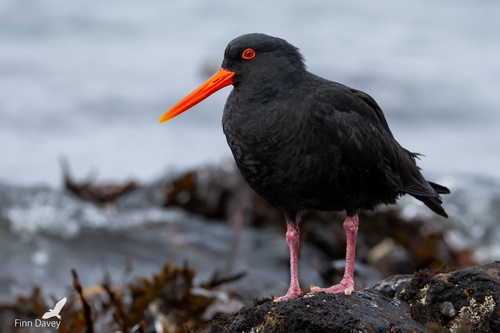
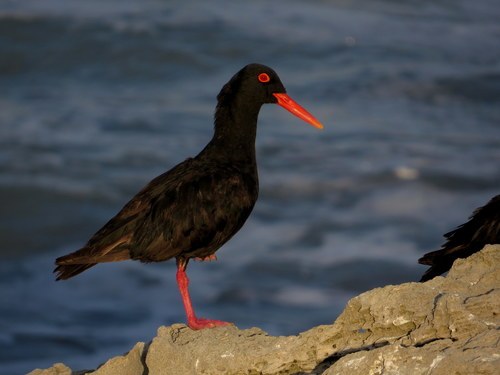
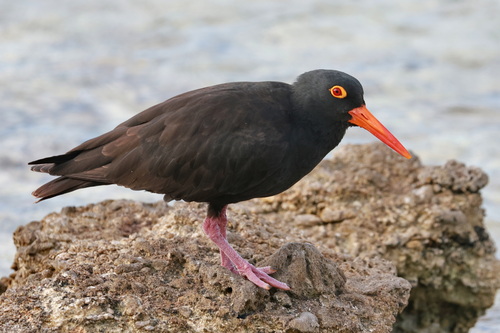
It has all-black plumage, pink-red legs, and a scarlet or orange-red bill and eyes.
Weight
It is the heaviest oystercatcher species, weighing up to 980 g (2.16 lb) with an average weight of around 819 g (1.806 lb).
Sexual Size Dimorphism
For both of its subspecies, females are larger and heavier than males.
Sexual Bill Dimorphism
Males have shorter, thicker bills, while females have longer, thinner bills; the average 19% difference in bill length is the most marked sexual difference in this trait among all oystercatcher species.
Immature Appearance
Immature sooty oystercatchers have grey-brown legs, a brown-tipped bill, a browner overall tone to their plumage, and brown eyes.
Immature Maturation Traits
Their bill, eyes, and legs all turn red by the bird's second year.
Distribution and Habitat
This species is endemic to Australia and prefers rocky shores.
Population Estimate
The total estimated population is 11,500 individuals, with 4,000 belonging to the nominate race and 7,500 to the northern race.
Common Range Locations
It is common around the Tasmanian coastline and Bass Strait islands.
Regional Conservation Statuses
It holds conservation statuses of Rare in South Australia and Queensland, Near Threatened in Victoria, and Endangered in New South Wales.