About Grevillea longifolia R.Br.
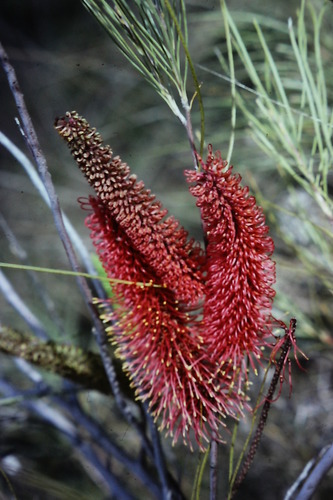
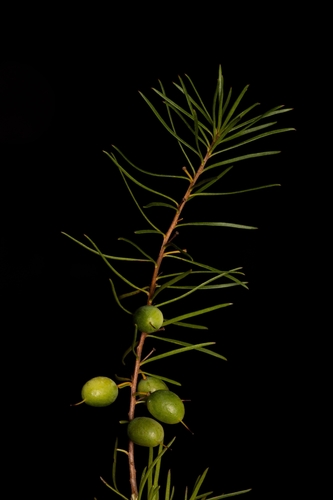
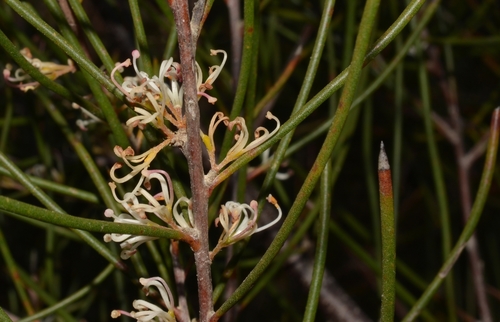
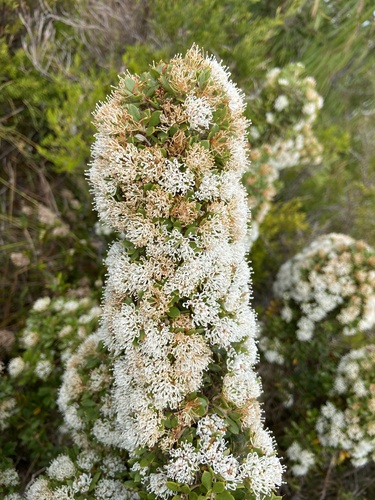
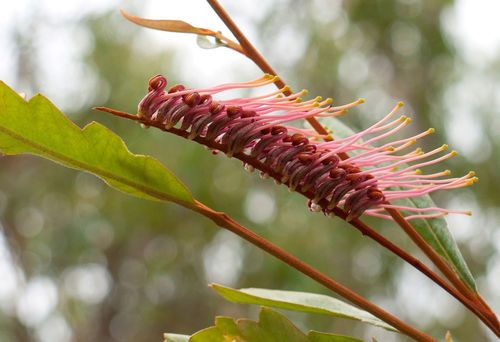
Grevillea longifolia R.Br. is an erect to spreading shrub that typically reaches 1.5 to 6 metres (4 ft 11 in to 19 ft 8 in) in height. Its leaves are narrowly egg-shaped, narrowly elliptic, or linear, 75–220 mm (3.0–8.7 in) long and 5–25 mm (0.20–0.98 in) wide. Most leaves have coarsely toothed edges, and some are pinnatifid; teeth, when present, are 3–6 mm (0.12–0.24 in) long. The lower leaf surface is covered with silky hairs. Flowers are arranged in toothbrush-like groups on a 45–75 mm (1.8–3.0 in) long rachis, and are pinkish-fawn with a pink to red style; the pistil is 21–24 mm (0.83–0.94 in) long. Flowering occurs from July to January, peaking in September, and the fruit is a 13–16 mm (0.51–0.63 in) long silky-hairy follicle.
This species is restricted to the Sydney Basin, particularly its southern areas and the Woronora Plateau. It grows in Heathcote and Royal National Parks, but has disappeared from Burwood and Carlton, districts where it once occurred. It grows on Hawkesbury Sandstone and yellow clay soils, often along riverbanks and streams, in shaded or part-shaded positions in woodland or forest. It grows under trees including blue leaved stringybark (Eucalyptus agglomerata), Sydney peppermint (E. piperita), stringybark (E. oblonga), smooth-barked apple (Angophora costata) and red bloodwood (Corymbia gummifera), alongside shrubs such as gymea lily (Doryanthes excelsa). Near creeks, it grows with shrubs Lomatia myricoides, watergum Tristania neriifolia, kanooka (Tristaniopsis laurina), and trees blackbutt (Eucalyptus pilularis) and coachwood (Ceratopetalum apetalum).
In ecological terms, this grevillea is killed by fire, but regenerates from seed. The seeds are sometimes eaten by insects, or by native mammals such as the bush rat (Rattus fuscipes) and swamp wallaby (Wallabia bicolor).
In horticulture, Grevillea longifolia adapts readily to cultivation. It can be propagated vegetatively by cuttings, because the species tends to hybridise, which makes the parentage of collected seed unclear. It is grown commercially in the south of France for its foliage. It is sometimes sold mistakenly labelled as G. aspleniifolia.