About Grevillea juniperina R.Br.
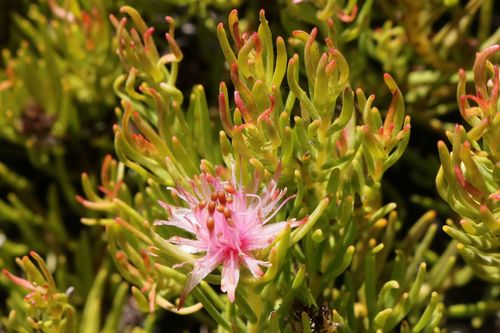
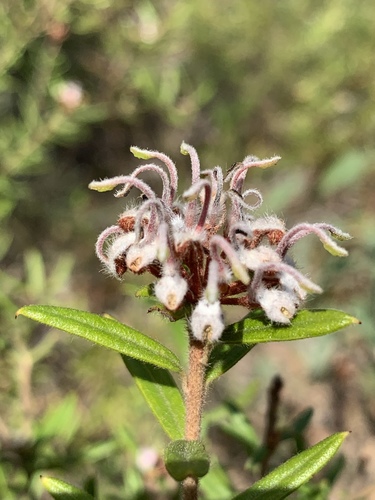
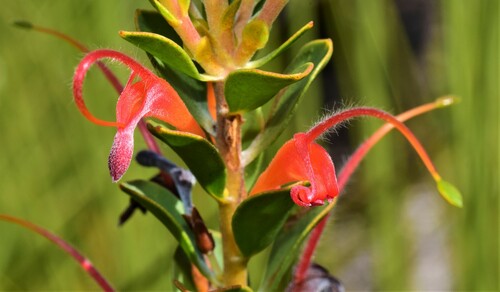
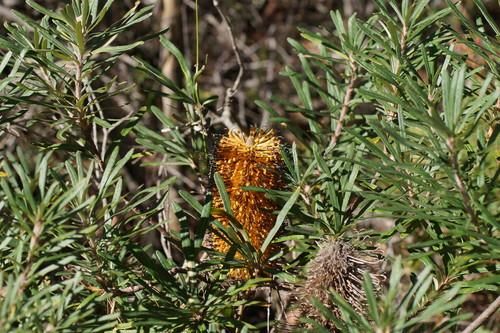
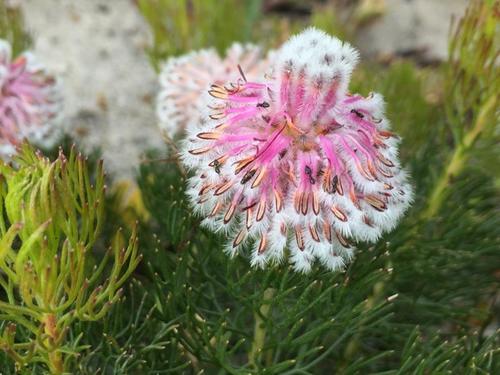
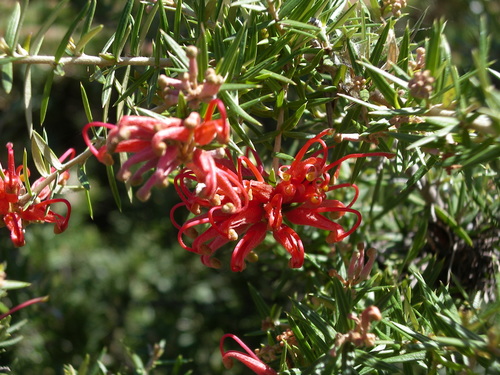
Grevillea juniperina R.Br. is a plant that grows as a spreading or erect shrub, reaching a height of 0.2–3 m (0.66–9.84 ft). Its branchlets are thick and sturdy. The prickly leaves are generally stiff, 0.5–3.5 cm (1⁄4–1+3⁄8 in) long and 0.5–6 mm (1⁄32–1⁄4 in) wide, and crowded along stems. Flowering occurs year-round, with peak flowering from midwinter to early summer; timing differs by subspecies: subspecies allojohnsonii flowers from September to February, subspecies trinervis from August to December, and subspecies juniperina, amphitricha, sulphurea, villosa and fortis flower in August and September. Its inflorescences are shaped like spider flowers, with many individual flowers emerging from a central rounded flower head, resembling spider legs. Flowers can be red, pink, orange, yellow, or greenish. They are mostly terminal, growing from stem ends, but occasionally grow from axillary buds. Flowers are 2.5–3.5 cm (1–1+3⁄8 in) long. The outside of the perianth is finely furred, while the pistil is smooth and measures 1.5–2.7 cm (5⁄8–1+1⁄8 in) long. After flowering, the plant produces seed pod capsules 10–18 mm (3⁄8–3⁄4 in) long, which release one or two seeds when ripe. Seeds are narrow and oval, 7.5–12 mm (1⁄4–1⁄2 in) long and 2.2–3.3 mm (1⁄16–1⁄8 in) wide, with a swelling at the apex, a short wing, and tiny hairs covering both surfaces. It is similar to two other Grevillea species: Grevillea molyneuxii (Wingello grevillea), which can be told apart by its prominent midvein on the leaf undersurface, and G. speciosa (red spider-flower), which has wider leaves with lateral veins and a longer pistil. Seven subspecies of Grevillea juniperina are found in eastern Australia, each with distinct distribution and habitat: Subspecies allojohnsonii occurs on the Northern Tablelands and North West Slopes of northern New South Wales, ranging from Walcha north to Tenterfield, and into Stanhope and Girraween National Park in southern Queensland. Subspecies amphitricha grows in woodland and grassland on slopes and ridges between Braidwood and Nerriga in the Shoalhaven River catchment on the Southern Tablelands. Subspecies fortis grows in forest, woodland, and shrubland on rocky hills and slopes near watercourses, specifically along Ginninderra Creek, the lower reaches of the Molonglo and Cotter Rivers, and the Murrumbidgee River from Pine Island downstream to its confluence with the Molonglo River, mostly within the Australian Capital Territory. Subspecies juniperina grows in forest or woodland, in the Cumberland Plain and Castlereagh Woodland communities on clay-loam soils, alongside Eucalyptus tereticornis (forest redgum), E. sideroxylon (mugga ironbark), E. eugenioides (thin-leaved stringybark), E. fibrosa (broad-leaved red ironbark), E. moluccana (grey box), Melaleuca decora (white feather honeymyrtle), Bursaria spinosa (boxthorn), Acacia falcata (sickle wattle), and Dillwynia tenuifolia. Annual rainfall in regions where G. juniperina grows ranges from 600 to 800 mm (24 to 31 in). Subspecies sulphurea grows on alluvial soils, often alongside Leptospermum species, along riverbanks in the catchments of the Coxs, Kowmung, Wollondilly and Shoalhaven Rivers in the Central and Southern Tablelands, from Tallong to Berrima, and from Lidsdale to Jenolan State Forest in the southwestern Blue Mountains. Subspecies trinervis is found in the western Blue Mountains, where it grows on poorly drained alluvial soil in woodland or along riverbanks in association with Eucalyptus pauciflora (snow gum), E. dalrympleana (mountain gum), Dillwynia retorta, and Lomatia myricoides (river lomatia). Subspecies villosa grows along watercourses in eucalypt forest east and northeast of Braidwood, and near Currockbilly in southeastern New South Wales. Grevillea juniperina is killed by bushfire, and regenerates after fire from dormant soil-stored seeds that germinate when stimulated by heat and smoke. Plants taller than 1 m (3.3 ft) produce more seed. Fire intervals of 10 to 15 years are thought to be most beneficial for the species' survival, as this allows seed numbers to build up in the soil over time. G. juniperina can colonise disturbed areas, but overgrowth of Bursaria spinosa can hinder its spread. It is pollinated by birds, and bees are also recorded visiting its flowers. Its leaves are a food source for caterpillars of the cyprotus blue butterfly (Candalides cyprotus). The Australian springtail species Calvatomina superba has been found on cultivated G. juniperina at the Lost Gardens of Heligan in Cornwall. Allan Cunningham sent seed of G. juniperina to England in 1820, and the species was grown there in 1821. Baron Charles von Hügel grew the species in Vienna in 1831. It has been grown outdoors in southern England, especially G. juniperina subspecies sulphurea. G. juniperina adapts easily to cultivation, growing in a wide range of soils and aspects in locations with good drainage. It flowers over a long period, and its nectar attracts birds including honeyeaters. Its prickly dense foliage provides good nesting sites and shelter, particularly for small birds such as finches. Many forms and hybrids have been commercially propagated and sold, with varying levels of horticultural appeal. Low winter temperatures encourage more prolific flowering, and pruning encourages dense foliage. Plants can be readily propagated from cuttings or seed, though propagation by cuttings is required to retain the parent plant's characteristics. Direct contact with the plant may cause a skin rash. Many cultivars have been selected for horticultural use, including naturally selected forms and hybrids with other Grevillea species. A prominent early breeder was Leo Hodge of W Tree, Victoria, who began breeding grevilleas after finding seedlings in his garden. His first trials crossed G. juniperina with G. victoriae, producing G. 'Poorinda Queen' (the first of his cultivars to flower), followed by G. 'Poorinda Constance', G. 'Poorinda Leane' and G. 'Poorinda Pink Coral' in 1952. Registered and selected cultivars include: 'Allyn Radiance', derived from a prostrate orange and a prostrate red form of G. juniperina; 'Audrey', a cross between G. juniperina and G. victoriae bred in 1957 by George Althofer and named for his wife, growing to 2 m (6.6 ft) high and wide with orange-red flowers over many months, popular in South Africa and the US; 'Canberra Gem', a cross between G. juniperina and G. rosmarinifolia registered with the Australian Cultivar Registration Authority in 1976; 'Canterbury Gold', a cross between a prostrate yellow form of G. juniperina and Grevillea parvula; 'Goldfever', a cross between G. juniperina and Grevillea rhyolitica; 'H22' (Gold Cluster), a dense, prostrate selection with yellow flowers; 'Lunar Light', a low-growing form with variegated leaves and orange-pink flowers, suitable for rockeries; 'Molonglo', a low-spreading form with larger orange flowers with red styles, bred in 1964 by Rudolph Willing of Australian National University from two different forms of G. juniperina (an erect red-flowered form from the Canberra area and a yellow-flowered spreading prostrate form from the western slopes of the Budawang Range), named after the Molonglo River; 'New Blood', a compact red-flowered shrub from a cross between the 'Molonglo' cultivar and G. rhyolitica; 'Old Gold', a low spreading shrub with yellow new growth, lobed leaves, and greyish-yellow flowers with pink styles, derived from a cross between G. juniperina and Grevillea ilicifolia; 'Orange Box', a cross between G. juniperina and G. victoriae; 'Pink Lady', a cross between G. juniperina and G. rosmarinifolia bred by Stan Kirby of Queanbeyan, widely grown in the early 1970s, a shrub reaching 60 cm (2.0 ft) high and 3 m (9.8 ft) wide with pale pink flowers; 'Poorinda Adorning', a seedling grown in Hodge's garden, first grown in 1965 and registered in 1978; 'Poorinda Annette', a cross with the small-flowered form of Grevillea alpina; 'Poorinda Beauty', a cross with Grevillea alpina; 'Poorinda Belinda', a cross with a hybrid between the yellow flower form of Grevillea obtusiflora and Grevillea alpina; 'Poorinda Constance', a cross with Grevillea victoriae; 'Poorinda Jeanie', a red-flowering shrub growing up to 2 m (6.6 ft) high, derived from a cross with Grevillea alpina; 'Poorinda Leane', a cross with G. victoriae, a spreading shrub reaching 4 m (13 ft) high with buff or apricot flowers; 'Poorinda Pink Coral', a cross with G. victoriae, named for the colour of its flowers; 'Poorinda Queen', derived from a cross with a yellow-flowered form of Grevillea victoriae, with apricot-pink flowers; 'Poorinda Refrain', a cross with Grevillea floribunda; 'Poorinda Rachel', a 1 m (3.3 ft) high hybrid cross with Grevillea alpina with buff-cerise flowers, developed in 1965–66; 'Poorinda Rosalie', a taller rose-red flowered hybrid with G. victoriae, developed in 1967–68; 'Poorinda Signet', a cross with Grevillea lanigera; and × semperflorens, a hybrid of English origin derived from a cross between Grevillea juniperina var. sulphurea and Grevillea thelemanniana.