About Banksia nobilis (Lindl.) A.R.Mast & K.R.Thiele
Growth Habit
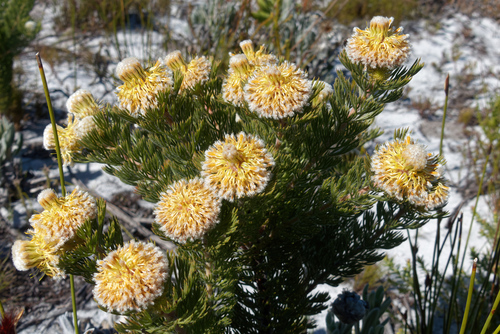
Banksia nobilis grows as a shrub reaching up to four metres in height.
Leaf Structure
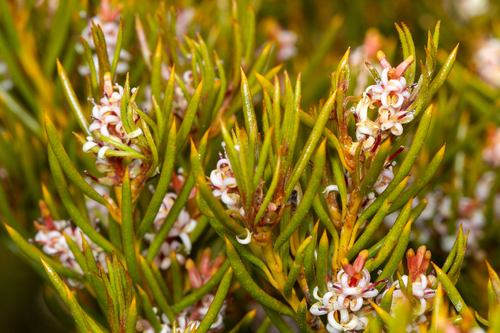
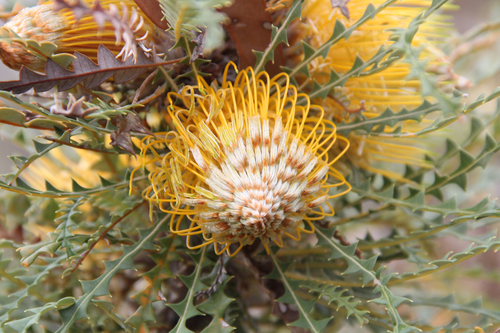
Its leaves are pinnatifid, with 14 to 32 triangular lobes on each side. Each leaf measures 8 to 22 centimetres long and 5 to 25 millimetres wide, and sits on a 5 to 15 millimetre long petiole.
Inflorescence Development
Inflorescences develop on short lateral branchlets. This species produces a very large number of inflorescences, often holding one inflorescence in almost every leaf axil.
Flower Coloration
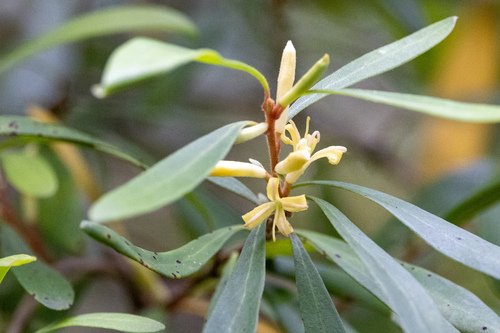
The flowers are golden or reddish pink, with a greenish cream limb.
Fruit Development
After flowering, each flower head can develop up to 5 follicles.
Distribution Range
This species is found on lateritic rises, ranging from Eneabba in the north to Katanning in the south. Most of its distribution roughly follows the boundary between the Jarrah Forest and Avon Wheatbelt biogeographic regions, and it extends into the Swan Coastal Plain and Geraldton Sandplains at its northern limits.
Habitat
Across most of its range, it grows in eucalypt woodland and tall shrubland, while it grows among thick kwongan at its northern extents.
Horticultural Popularity
Banksia nobilis subsp. nobilis has long been a popular garden plant valued for its prolific flowering.
Cultivation Requirements
It grows best in heavy, gravelly soil with excellent drainage, placed in a sunny position. It is both drought tolerant and frost tolerant, surviving temperatures as low as −7 °C.
Pruning Recommendation
Older plants become straggly and untidy, so pruning when young is recommended.
Propagation Methods
Propagation is typically done by seed, because the plant’s hairy stems make striking stem cuttings almost impossible, and heel cuttings have only had limited success.
Seed Germination
Seed germination takes three to four weeks, and has a very high success rate. Plants usually start flowering three to four years after being grown from seed.
Subspecies fragrans Cultivation Status
Very little cultivation information is available for Banksia nobilis subsp. fragrans, as it is new to cultivation. It likely needs similar growing conditions to subspecies nobilis, but is better adapted for warmer areas.