About Grampus griseus (G.Cuvier, 1812)
Body and Dorsal Fin Shape
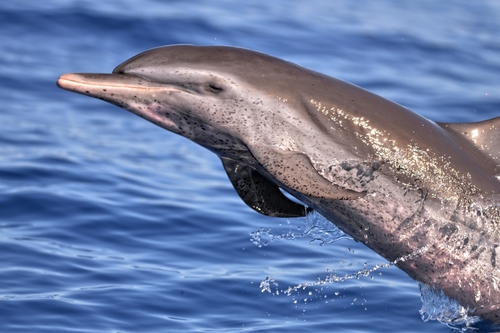
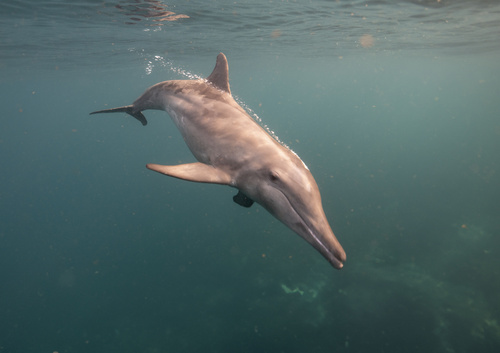
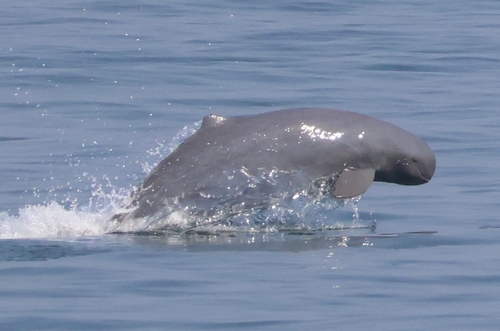
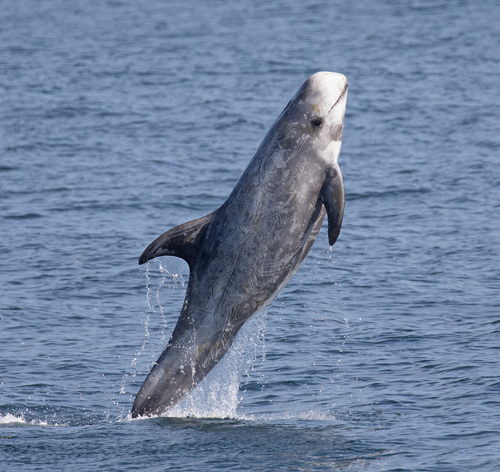
Grampus griseus, commonly known as Risso's dolphin, has a relatively large anterior body and dorsal fin, while its posterior body tapers to a relatively narrow tail. Its bulbous head has a vertical crease on the front.
Infant Coloration
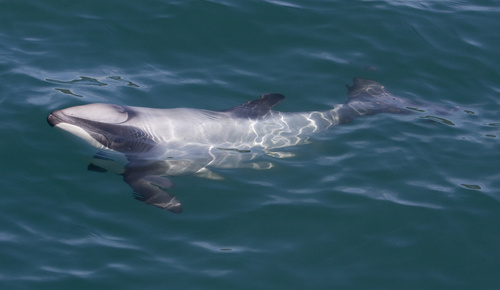
Infants are grey to brown on their dorsal side and cream-colored ventrally, with a white, anchor-shaped area between their pectoral fins and around the mouth. In older calves, the nonwhite areas of the body darken to nearly black, then lighten again — the dorsal fin, however, always remains dark.
Body Scarring
Linear scars, mostly caused by social interaction, eventually cover most of the body. While scarring from male-to-male competition is common among toothed whales, Risso's dolphins tend to have unusually heavy scarring.
Scarring Function
These scars are very noticeable because the skin does not re-pigment after scarring; this lack of repigmentation may be advantageous, as the scars act as a display that reduces further challenges from other males. Older individuals appear mostly white.
Dentition
Most individuals have only two to seven pairs of teeth, all located in the lower jaw.
Adult Length
Typical adult length is 10 feet (3.0 meters), though some specimens can reach 13 feet (4.0 meters). Like most dolphin species, males are typically slightly larger than females.
Adult Weight
This species weighs between 300 and 500 kg (660 to 1,100 lb), making it the largest species commonly called a "dolphin".
Global Distribution
Risso's dolphins are found almost worldwide across cold, temperate, and tropical waters, occurring in the Indian, Pacific, and Atlantic Oceans, as well as parts of the Baltic Sea, Persian Gulf, Mediterranean Sea, North Sea, and Red Sea. They are not found in the Black Sea, though a rare stranding was recorded in the Sea of Marmara in 2012.
Denmark Sightings
Several sightings have been documented in Roskilde Fjord, in the waters of Lejre Vig just off the coast of Skjoldungernes Land National Park, Denmark.
Mitochondrial DNA Variation
Analysis of Risso's dolphins from the UK and the Mediterranean shows variations in mitochondrial DNA, and one possible explanation for these differences is a lack of interaction between individuals from the two locations.
Pacific Range
In the Pacific, their range extends from French Polynesia west to Samoa, north to the Hawaiian Islands, and as far north as the Gulf of Alaska. They are absent from western Pacific waters off the coast of Asia beyond Futuna.
Eastern Pacific Range
They are quite common along the western coasts of British Columbia, the United States, and Mexico, and their range continues to the southern tip of Tierra del Fuego.
Eastern Atlantic Range
In the eastern Atlantic, they have been sighted as far south as the offshore waters of Liberia and Guinea in West Africa, and north through the Canary Islands and the Azores to southern Greenland.
Western Atlantic Range
On the western Atlantic side, Risso's dolphins have been seen as far south as Guyana and Martinique; they can be found throughout much of the Caribbean Sea and the Gulf of Mexico, reaching Florida, the Bahamas, and the entire American East Coast as well as the Canadian Maritime Provinces.
Preferred Habitat Depth
Their preferred habitat is just off the continental shelf, on steep banks, in water depths between 400 and 1,000 m (1,300 and 3,300 ft).
Preferred Water Temperature
They prefer water temperatures of at least 10 °C (50 °F), and most commonly 15 to 20 °C (59 to 68 °F).
Diving Behavior
They have been recorded diving to depths of 600 m (2,000 ft) while pursuing prey.
Norwegian Coast Range Expansion
Since at least 2017, Risso's dolphins have begun appearing off the subarctic Norwegian coast, as far north as Bleik's Canyon off Andøya. Repeated, regular sightings in this area imply an expansion of the species' natural range.
Range Expansion Causes
Possible explanations for this northward movement include climate change, shifting water currents, northward migration of their prey species, or competition with other cetaceans such as pilot whales.
Population Estimate Challenges
Due to the species' low population density, it is widely considered very difficult to produce an accurate population size estimate for any area.
Primary Diet and Feeding Timing
In terms of ecology, Risso's dolphins feed almost exclusively on neritic and oceanic squid, and do most of their feeding at night.
Predation and Strandings
Significant predation on this species does not appear to be common, and mass strandings are infrequent.
Scottish Waters Prey
Analysis of stomach contents from stranded specimens in Scotland showed that the most important prey species for Risso's dolphins in Scottish waters is the curled octopus (Eledone cirrhosa).
Santa Catalina Island Sympatry
A population of Risso's dolphins lives off Santa Catalina Island, where it is sympatric with short-finned pilot whales (Globicephala macrorhynchus); both species feed on the local squid population.
Fishing Boat Feeding Interaction
While the two species have not been observed interacting with each other, both take advantage of commercial squid fishing that occurs at night, and fishermen have observed both species feeding around their fishing boats.
Interactions With Other Cetaceans
Risso's dolphins also travel with other cetaceans, and will surf the bow waves of gray whales as well as natural ocean swells.
Social Organization Structure
Risso's dolphins have a stratified social organization. They typically travel in groups of between 10 and 51 individuals, but can sometimes form "super-pods" that reach up to several thousand individuals.
Subgroup Composition
Smaller, stable subgroups exist within these larger groups, and these subgroups tend to consist of individuals of similar age or sex.
Group Fidelity
Risso's dolphins show fidelity to their groups. Long-term social bonds are most common among adult males.
Younger Individual Group Fidelity
Younger individuals have lower group fidelity, and can leave and join different groups.
Mother-Calf Group Fidelity
Mothers show high fidelity to mother-calf groups, but it remains unclear whether these females stay together after their calves leave, or if they remain in their natal pods.
Gestation and Calving Interval
For reproduction, gestation is estimated to take 13 to 14 months, and calving occurs at intervals of 2.4 years.
Calving Seasonality
Calving has seasonal peaks: in winter in the eastern Pacific, and in summer and fall in the western Pacific.
Sexual Maturity Age
Females reach sexual maturity at 8 to 10 years of age, while males reach sexual maturity at 10 to 12 years.
Maximum Recorded Lifespan
The oldest recorded specimen lived to 39.6 years of age.
Captivity History
Risso's dolphins have been successfully kept in captivity in Japan and the United States, though they are not captured or held as regularly as bottlenose dolphins or orcas.
Hybridization With Bottlenose Dolphins
Recent studies have suggested that hybridization can occur between Risso's dolphins and bottlenose dolphins; to date, possible hybrid individuals have only been documented in waters around the United Kingdom.
Hybridization Significance
Hybridization is not uncommon among cetaceans, so these hybrids likely do not have any evolutionary advantage, and are instead an uncommon chance event.