About Grallaricula flavirostris (P.L.Sclater, 1858)
Genus Context
Grallaricula, the genus that includes this species, are very small Andean antpittas, found mostly in low dense vegetation such as treefall gaps, stream edges, and bamboo thickets.
Species Size and Weight
The ochre-breasted antpitta (Grallaricula flavirostris) is about 10 cm (3.9 in) long and weighs 14 to 18 g (0.49 to 0.63 oz).
Nominate Subspecies Plumage Similarity
The sexes share identical plumage.
Nominate Subspecies Head Markings
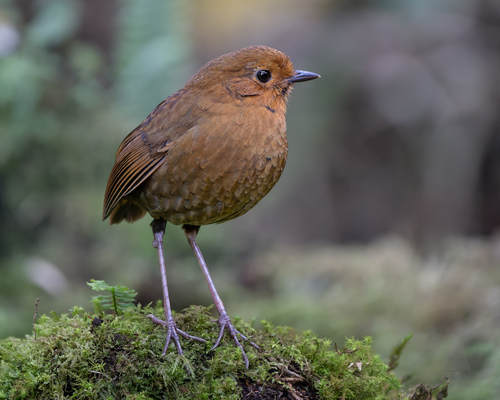
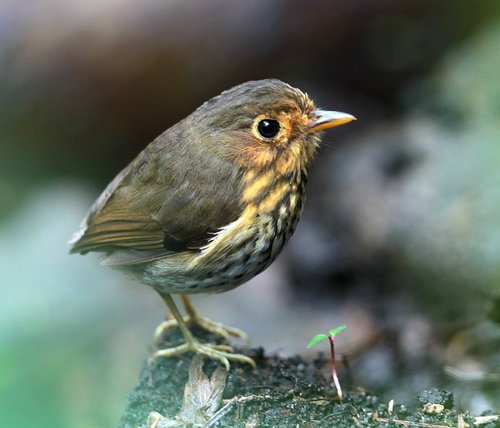
Adults of the nominate subspecies G. f. flavirostris have ochraceous lores, an ochraceous eyering, and a black malar stripe on a somewhat darker ochraceous face.
Nominate Subspecies Upperparts
Their upperparts are olive-brown with a light gray wash on the crown.
Nominate Subspecies Wing Features
Their wings are olive-brown with rufescent brown edges on the flight feathers.
Nominate Subspecies Underparts (Throat to Breast)
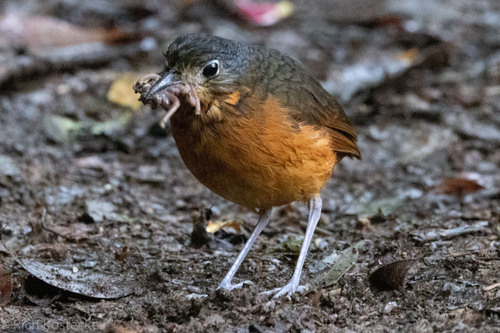
Their throat and breast are ochraceous, with olive-brown streaks or scallops on the breast.
Nominate Subspecies Flank and Ventral Features
Their flanks are tawny, sometimes marked with short dusky streaks. Their belly and crissum are white.
Nominate Subspecies Bare Parts
They have a dark brown iris, a blackish bill with a pinkish gray base to the mandible, and pinkish gray legs and feet.
G. f. costaricensis Traits
Other subspecies differ from the nominate and from each other as follows: G. f. costaricensis is similar to the nominate, with fewer dusky marks on the underparts.
G. f. brevis Traits
G. f. brevis is more olivaceous, has a grayer crown than the nominate, and also has fewer dusky marks on the underparts.
G. f. ochraceiventris, G. f. mindoensis, G. f. zarumae Traits
G. f. ochraceiventris, G. f. mindoensis, and G. f. zarumae are nearly alike, but their underparts are highly variable: their breasts range from almost plain to heavily streaked, their bellies are white or light ochraceous, and their bills can be entirely yellow, or have a dark maxilla and yellow mandible.
G. f. similis Traits
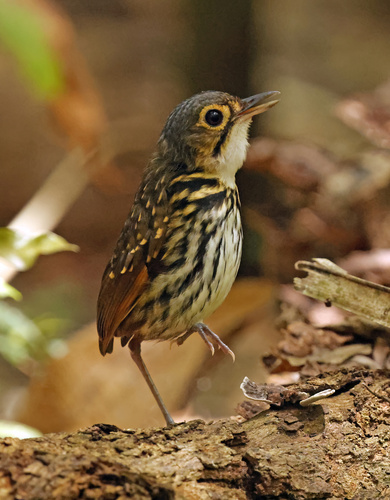
G. f. similis has a wide buff eyering, a buff and blackish malar stripe, brown upperparts with an olive wash and darker crown and nape, a buff throat with blackish streaks and a white crescent below it, a buff breast heavily marked with darker V-shaped scallops, a white belly, and buff-brown flanks with black scallops.
G. f. boliviana Traits
G. f. boliviana has a wide buff eyering, a buff and blackish malar stripe, brown upperparts with a gray-tinged crown, a buff throat with blackish streaks and a white crescent below it, a buff breast with darker V-shaped scallops (less heavily marked than in similis), a white belly, and buff-brown flanks with black scallops.
Distribution Pattern
The ochre-breasted antpitta has a disjunct distribution, and few of the subspecies' ranges are contiguous.
G. f. costaricensis Range
The ranges of each subspecies are as follows: G. f. costaricensis is found on the Caribbean slope of Costa Rica from central Alajuela Province south, on the Pacific slope of Costa Rica from central San José Province south, and extends into western Panama as far as Veraguas Province.
G. f. brevis Range
G. f. brevis occurs in eastern Darién Province in eastern Panama.
G. f. ochraceiventris Range
G. f. ochraceiventris is found in Colombia's Western Andes; isolated populations in the northern Central Andes and Serranía de los Yariguíes on the west slope of the Eastern Andes may belong to this subspecies.
G. f. mindoensis Range
G. f. mindoensis occurs from southwestern Colombia's Nariño Department into northwestern Ecuador, reaching Esmeraldas and Pinchincha provinces.
G. f. zarumae Range
G. f. zarumae is found in El Oro and western Azuay provinces in southwestern Ecuador.
G. f. flavirostris Range
G. f. flavirostris occurs on the Amazonian slope of the Andes from Colombia through Ecuador and possibly into extreme northern Peru.
G. f. similis Range
G. f. similis occurs in Peru from the Marañón River south to Pasco Department, and possibly extends further.
G. f. boliviana Range
G. f. boliviana occurs from Pasco in central Peru southeast to Puno Department, and extends into central Bolivia as far as Cochabamba Department.
Habitat Type
The ochre-breasted antpitta inhabits the undergrowth of humid to wet montane forest in the foothill and subtropical zones.
Overall Elevation Range
Across its entire range, it mostly occurs between 900 and 2,200 m (3,000 and 7,200 ft) in elevation.
Costa Rica Elevation Range
On Costa Rica's Caribbean slope it occurs between 700 and 1,500 m (2,300 and 4,900 ft), and on Costa Rica's Pacific slope between 900 and 1,800 m (3,000 and 5,900 ft).
Colombia Elevation Range
In Colombia it occurs between 500 and 2,000 m (1,600 and 6,600 ft).
Ecuador Elevation Range
In Ecuador it mostly occurs between 800 and 2,000 m (2,600 and 6,600 ft), but occurs locally at lower elevations in the southwest.
Peru Elevation Range
In Peru it occurs between 1,300 and 2,300 m (4,300 and 7,500 ft), and locally down to 800 m (2,600 ft).