About Grallaria gigantea Lawrence, 1866
Nomenclature and Common Name
Grallaria gigantea, or giant antpitta, is a very large antpitta as reflected in its scientific name.
Size and Weight
Its length ranges from 24 to 28 centimetres (9.4 to 11.0 in), and it can weigh up to 300 grams (10.6 oz).
This makes it by far the heaviest of all tracheophone suboscine birds.
Its closest competitor for this title, the chestnut-throated huet-huet, is not known to weigh more than 185 grams (6.5 oz).
Dorsal Plumage Coloration
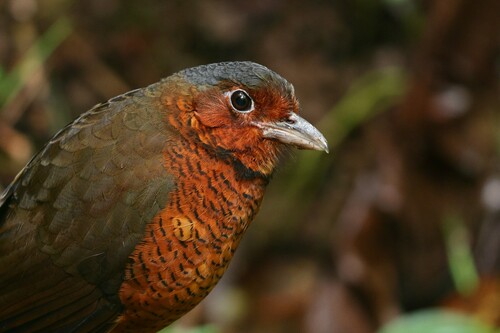
The back, wings, and stubby tail of G. gigantea are dusky olive-brown.
The top of its head is pale to medium grey, and this grey colour extends down to its neck.
Ventral Plumage Coloration
The rest of its plumage is deep rufous-brown.
Feathers on the throat and breast have black edges, which creates dark barring in these areas.
Soft Part Morphology
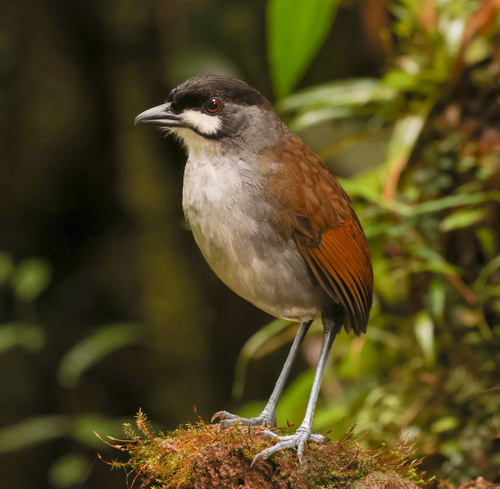
Its bill is dark, strong, and heavy; its eyes are also dark, while its legs and feet are grey.
Song Basic Structure
The song of this species is made up of low-pitched fast trills, with roughly 14 to 21 notes per second.
Trills are held for several seconds, during which they rise in pitch and get louder.
Song Pause Pattern
After a pause of a few to around twelve seconds, the trills are repeated.
The length of this pause changes irregularly through the full song.
Morphological Comparison with Related Species
The closely related undulated antpitta (G. squamigera) is slightly smaller than G. gigantea, it has a pale-hued malar region and a yellower belly.
Song Comparison with Related Species
While their songs are hard to tell apart, the undulated antpitta's song does not simply end after a period; instead, it finishes with additional trills separated by pauses that get longer over time.
Historical Range of G. g. lehmanni in Colombia
In Colombia, the subspecies G. g. lehmanni historically lived on both slopes of the Cordillera Central.
Specimens of this subspecies were collected in Cauca and Huila Departments before the mid-20th century, with one specimen collected in 1941 in what is now Puracé National Natural Park.
Current Status of G. g. lehmanni in Colombia
However, G. g. lehmanni has not been definitely relocated in this area since collection.
The species was recorded in La Planada Nature Reserve, Nariño Department, in 1988 and 1989, but the taxonomic identity of these recorded birds needs to be verified.
Historical Range of G. g. gigantea in Ecuador
In Ecuador, the nominate subspecies G. g. gigantea was previously more widespread along the eastern slope of the Andes.
Current Status of G. g. gigantea in Ecuador
In recent times, its presence is only confirmed in western Napo Province.
It was formerly found in eastern Carchi and Tungurahua Provinces, and it may still occur there in protected habitats.
Range of G. g. hylodroma in Ecuador
The subspecies G. g. hylodroma occurs on the western slope of the Andes in Pichincha and Cotopaxi Provinces.
Historical Specimens of G. g. hylodroma
There are two old specimens thought to belong to hylodroma: one from a site called "El Tambo" that has not been definitively relocated (but is probably located in western Cañar Province), and one from Cerro Castillo in western Pichincha Province.
The El Tambo site is quite far outside the species' currently known range.
Primary Natural Habitats
The natural habitats of G. gigantea are subtropical to temperate moist montane forests.
Elevation Range by Subspecies
Subspecies hylodroma has been recorded between 1,200–2,000 m (3,900–6,600 ft) above sea level, while nominate gigantea occurs from above 2,200 m (7,200 ft) ASL, and lehmanni has been recorded at 3,000 m (9,800 ft) ASL.
Alternate Occurrence Habitats
Occasionally, G. gigantea can be found in cloud forest swamps with abundant understory, pastures, and secondary forest.
Overall, however, the species' survival appears to depend on primary forest.
Primary Diet Components
The diet of G. gigantea is mostly made up of terrestrial invertebrates, but arthropods do not seem to be a key food source.
Instead, large Rhinodrilus earthworms are likely a staple food.
Additional Recorded Prey
Beetle larvae and slugs have also been recorded as prey for this species.
Reproduction Knowledge Status
Very little is known about the species' reproduction.
Recorded Fledgling Feeding Observation
On April 19, 2001, an adult G. g. hylodroma was observed feeding a large earthworm to a recently fledged young at the Pacha Quindi Nature Refuge and Botanical Gardens.