About Grallaria ridgelyi Krabbe, Agro, Rice, Jacome, Navarrete & Sornoza, 1999
Grallaria Antpitta Genus Traits
Grallaria antpittas, the group this species belongs to, are described as a wonderful group of plump, round antbirds whose feathers are often fluffed up; they have stout bills and very short tails.
Jocotoco Antpitta Size
The jocotoco antpitta (Grallaria ridgelyi) is the largest member of its antpitta family. It measures 20 to 24 cm (7.9 to 9.4 in) long and weighs about 150 to 200 g (5.3 to 7.1 oz).
Plumage Sexual Dimorphism
Males and females have identical plumage.
Adult Head Plumage
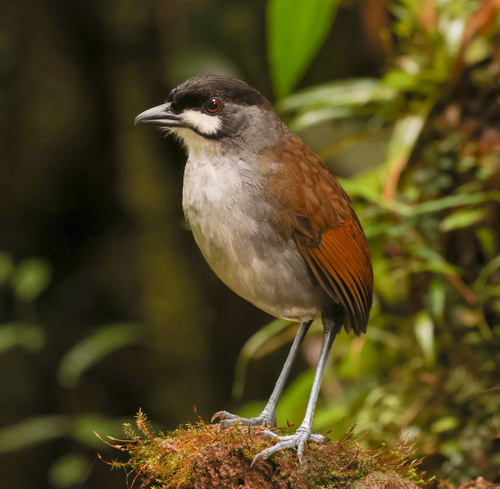
Adult jocotoco antpittas have a black crown and brownish olive nape, with a large, somewhat shaggy, fan-shaped white patch extending from the bill to below the eye. Their ear coverts are gray.
Upperparts Plumage
Their upperparts are brownish olive with a black wash that becomes less prominent from the mantle to the rump. Their tail is reddish brown.
Wing Plumage
Their flight feathers have blackish inner webs and cinnamon outer webs, and their upperwing coverts are brownish olive with a black band.
Underparts Plumage
Their throat is snowy white. Most of their underparts are light gray, which darkens on the flanks; the flanks also have a brownish olive wash. Their undertail coverts are brownish olive with fine black bars.
Soft Part Traits
Both sexes have a dark red to crimson reddish brown iris, a black bill, and blue-gray legs and feet.
Juvenile Plumage
Juveniles are similar to adults but have more muted coloration and a chestnut crown.
Species Distribution Range
The jocotoco antpitta is known only from a very small number of locations in southeastern Ecuador and adjacent Peru. It was originally thought to be restricted to the upper Chinchipe River drainage in Zamora-Chinchipe, Ecuador, but a population was discovered in 2006 in Cordillera del Cóndor, Cajamarca, Peru.
Habitat Characteristics
It lives on steep slopes in wet, dense, mossy forest that contains Chusquea bamboo stands and silvery-leaved Cecropia trees.
Elevational Range
In Ecuador, it occurs at elevations between 2,300 and 2,650 m (7,500 and 8,700 ft). Observations of the Peruvian population were made at about 2,250 m (7,400 ft).