About Georychus capensis (Pallas, 1778)
Body Form
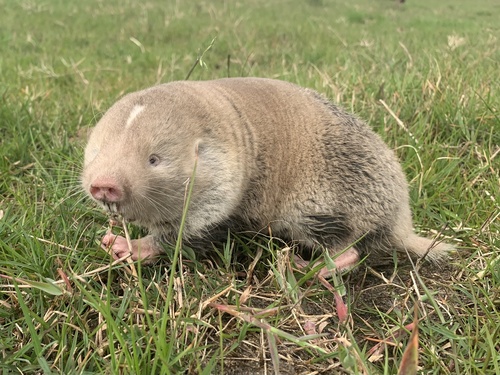
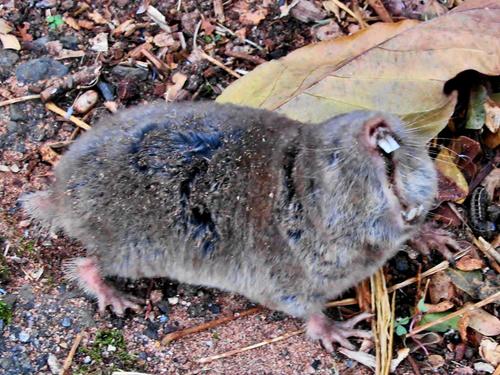
Georychus capensis, commonly known as Cape mole-rats or blesmols, closely resemble other African mole-rats in physical appearance. They have cylindrical bodies with short limbs, and large feet with leathery soles.
Senses
Their head is large and rounded, and their tail is short, with only a few sparse hairs. Like other mole rats, they have no external ears. Their eyes are very small, but they are functional. When Cape mole-rats exceptionally leave their tunnels, their vision is good enough to let them actively turn and use their powerful incisors to repel approaching attackers.
Size and Sex
Adults measure around 16 centimetres (6.3 in) in head-body length, with a 2 centimetres (0.79 in) tail, and weigh around 180 grams (6.3 oz). Females have three pairs of teats. Cape mole-rats are most easily distinguished from other mole-rat species by the color pattern of their fur.
Fur Coloration
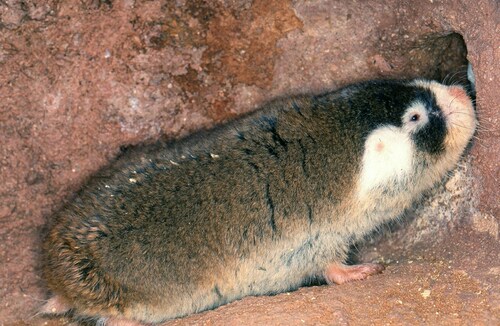
Most noticeably, they have prominent white blazes around their ears and eyes, plus smaller white fur patches on the muzzle, and often on the top of the head. These white patches give the species its common name blesmol, which means "blaze mole" in Afrikaans. Most of the fur across the rest of the body is russet in color, with distinct silvery-white underparts.
Coat Details
The head is darker, sometimes even a charcoal grey shade. The hair on the feet is also white.
Fur Texture
Unlike the related Damaraland mole-rats, Cape mole-rats have no guard hairs. They do have slightly longer stiff hairs around the mouth and feet, and they have stubby whiskers. Lacking guard hairs, their fur has a thick and woolly texture.
Range
Cape mole-rats inhabit forested and savannah regions across the coastal areas of Western Cape and Eastern Cape provinces in South Africa. Isolated populations have also been reported from KwaZulu-Natal, just east of Lesotho, and from Mpumalanga.
Subspecies
No formally recognized subspecies of Cape mole-rats exist, but this may be due to limited research on the species; it has been proposed that the KwaZulu-Natal mole rats may represent a completely distinct species. Cape mole-rats apparently prefer sandy loam, alluvium, or clay soils.
Fossil Record
Fossils of Cape mole-rats are known from the middle Pleistocene of Elandsfontein in the Western Cape. Fossils that belong to the genus Georychus, but not to this living species, have been identified from the lower Pleistocene at Swartkrans.
Drumming
During the summer mating season, both male and female Cape mole-rats drum on the sides of their tunnels with their hind feet, using a different signal than they use to warn off potential intruders during other seasons. The drumming is loud enough to be heard above ground from a distance of up to 10 metres (33 ft) away.
Courtship
Once a male finds a mate, courtship and mating are brief, and interspersed with periods of grooming. Gestation lasts 44 to 48 days, and a litter of three to ten young is born between August and December.
Newborns
Newborn Cape mole-rats are born hairless and blind, weighing only 5 to 12 grams (0.18 to 0.42 oz), and measuring 3 to 4 centimetres (1.2 to 1.6 in) in length. Fur begins to grow on the seventh day after birth, and the eyes open on the ninth day.
Growth
The young grow rapidly, and begin to take solid food around day seventeen, and are fully weaned at four weeks of age. By five weeks, siblings begin to show aggression toward one another, and they leave to establish their own burrows at around seven weeks.
Maturity
Cape mole-rats reach sexual maturity at eighteen months of age, and live up to five years.