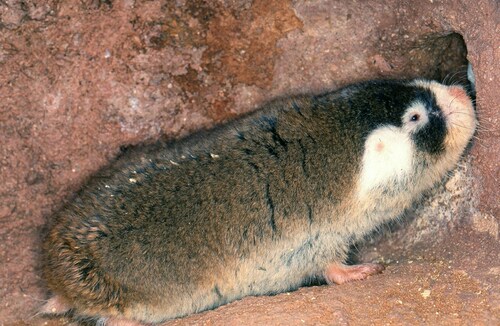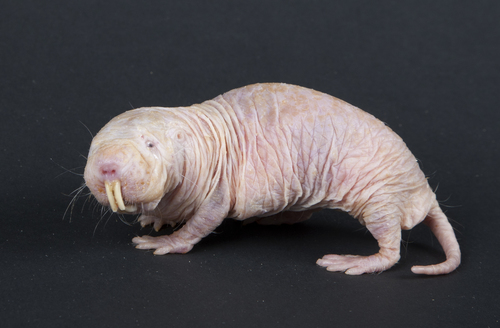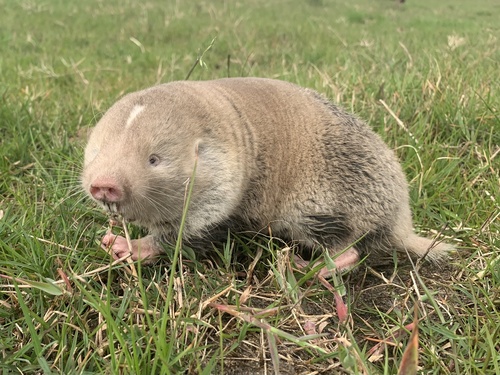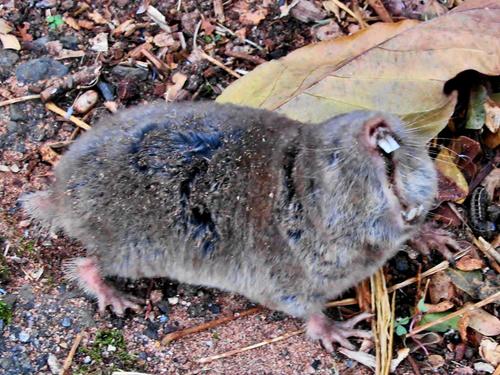
About Cryptomys hottentotus natalensis Roberts, 1913
Common Name and Taxonomy
Cryptomys hottentotus, commonly known as the common mole-rat, African mole-rat, or Hottentot mole-rat, is a burrowing rodent belonging to the subfamily Bathyerginae.
Geographic Distribution
This species is found in Southern Africa, and it occurs specifically in the Western Cape province of South Africa, as well as in Eswatini, Lesotho, Malawi, Mozambique, Tanzania, Zambia, and Zimbabwe.
Colony Social Structure
Common mole-rats live in colonies that function as family groups, where only the largest female and largest male act as the reproductive pair.
Mating Period
Mating starts in September and October.
Courtship Behavior
During courtship, the female raises her tail to allow her mate to smell her genital region. The male then gently chews on her hind region, before mounting and mating.
Litter Production
Offspring are only born during southern hemisphere summer, and a pair may produce one or two litters per season with up to five pups per litter.
Gestation Period
The gestation period for this species is approximately 81 days.
Reproductive Maturity
Individuals reach reproductive maturity at an average of 450 days old, and females retain reproductive function even during non-reproductive months.
Habitat and Substrate Adaptability
Common mole-rats are fully fossorial, and can inhabit a wide range of soil substrates.
Diet
They are herbivorous, feeding primarily on geophytes (plants with underground storage organs) and grass rhizomes.
Population and Distribution Patterns
While the species is very widespread, its overall total abundance is not well understood. The species shows localized distribution patterns tied to specific soil requirements.
Burrow Structure Function
The burrowing system structure of common mole-rats is optimized to maximize access to food, particularly geophytes.
Economic Impacts of Burrowing
Their burrowing activity has both negative and positive economic impacts: it causes damage to human property, but it also improves soil drainage and soil turnover.